In yesterday's issue of USA Today, there was an interesting article by Dan Reed on Airlines losing a record number of bags last year. As a air traveler for many years, I have experienced the pain of losing my bags after a flight. It is not a pleasant customer experience. After quickly reading the article, I thought that of all problems that could be considered for a Six Sigma project, this would be one wickedly cool project!
Based on the numbers contained in the article, a major quality improvement by any airline in their lost bags metric would greatly improve customer satisfaction and boost the bottom line. What was the cost of this poor quality performance? The article estimated the cost to the airlines for loss bags to be $2.5 billion. With the current financial situation of the airlines, this would be a huge improvement opportunity.
According to the article, 30 million bags were lost out of 3.7 billion bags checked in last year. With less than 1% error rate, it was stated this 99% success rate would be considered good in many industries but basically is unacceptable for the airlines. OUTSTANDING quality viewpoint! Do not accept the 99% success rate as good enough.
Using these numbers, the airline lost baggage rate is 8,108 Parts Per Million opportunities defective(PPM rate). In the six sigma world, that would be under a 4 sigma performance level. Remember a six sigma level would be only 3.4 parts per million (PPM) defective.
Without many of the details, it would be difficult to analysis the problem. However, the article did help point out some focus areas. With about 61% mishandled bags occurring on baggage transferred from one flight to another (versus direct flights), I would obviously focus investigative efforts on this process. In addition, 15% of the errors were due to the airlines failing to load them on the proper fights. Sounds like there is some level of data to start a formalized problem solving investigation.
By asking the 5 why's, along with Pareto charts and cause/effect analysis, the airlines could begin to see the root causes for lost bags and start countermeasures to poka-yoke (mistake-proof) the process. With all due respect to the airlines, this improvement process sounds easy, when in fact, it is difficult to isolate these common cause variations and prevent them from occurring. Difficult but certainly not impossible!
My advice to the airlines, don't focus on layoffs and pay cuts that further erode your employee relations. That short term thinking to cut costs will not build your team that you need to be more competitive for the future. The negative price you pay is too high. Instead, work together with your employees and try a focused six sigma program. As a team, go after the $2.5 billion along with other process improvements. You need the money, but more importantly, a large number customers will be transformed into extremely happy passengers!
Wednesday, March 22, 2006

Friday, March 17, 2006
Kaizen Priorities Part 2
My post on Kaizen Priorities caught the attention of Bill Waddell over at Evolving Excellence blog that inspired him to write Lean Manufacturing providing his opposing view on this topic. In my opinion, Bill has excellent viewpoints on lean and provides passionate insights to lean manufacturing. However, I think just a little bit differently than Bill on this topic.
First, the points that I am promoting in Kaizen Priorities are simply to 1) avoid debates and arguments about lean like this one and just start improving, and 2) there are some weaknesses held against the lean approach and that targeted kaizen may yield visible results faster. I guess I failed on both points. The post did not in any way, shape or form pretend to describe the entire scope and the core essence of kaizen or the Toyota Production System. One short post could possibly do it.
Second, I am positive that we can all agree that any improvement in business is good. According to the Japanese business philosophy as described by Massaki Imai, "Whenever and wherever improvements are made in business, these improvements are eventually going to lead to improvements in areas such as quality and productivity."
So how can any suggestions for improvement be "wrong"?
As far as I know, it is correct to state that Taiichi Ohno and Shigeo Shingo did not directly promote looking at bottlenecks. It is well documented, Taiichi Ohno believed strongly that the starting point of kaizen is being aware or recognizing a problem first. See the need, then start at the problem. His definition of a problem took the form of a burden to people or inconvenience downstream to other employees or customers.
This point leads to the concept of kaizen. I was taught kaizen is more than just continuous improvement of a process or cycle time focused, it is about people. The meaning of kaizen includes the development, training and improvement of people along with removing the burdens that people deal with in work. This higher principle of kaizen is found in my suggestions to look at removing bottlenecks and improving the hardest job in the organization.
Shigeo Shingo stated, "There are four purposes of improvement: easier, better, faster and cheaper. These four goals appear in the order of priority." This viewpoint, again, starts with people. According to Bill's post, we must concentrate on compressing cycle time. This approach just focuses on "faster" and ignores "easier, better and cheaper." All my kaizen suggestions are aimed at easier, better and faster thinking cheaper will follow.
Finally, the disagreement with my suggested kaizen priorities could be just the differences between Japanese management and American management approaches. The Japanese management approach is geared towards long term thinking and process orientation whereas the American management approach is bias towards short term thinking and results orientation. Look at promotions, hiring and firing in America, it is all results based. Just look at nearly every management performance review in America, it's results that matter most( not attitude, effort, techniques or methods). We measure companies on the bottom line, we measure coaches on win-loss records and we measure people on getting the job done with results.
My kaizen priorities are an attempt to go from a process orientation versus results orientation conflict into believing both are equally important, its process orientation and results orientation. Just like the quality and cost goals should be equally important and not one versus the other. With this viewpoint, I attempted to stay true to the meaning of kaizen by removing burdens to people (bottlenecks, tough jobs, etc) while achieving visible results.
Repeating the words of Massaki Imai, "Whenever and wherever improvements are made in business, these improvements are eventually going to lead to improvements in areas such as quality and productivity." As I see it, the biggest problem that American management has with this is the "eventually" part.
First, the points that I am promoting in Kaizen Priorities are simply to 1) avoid debates and arguments about lean like this one and just start improving, and 2) there are some weaknesses held against the lean approach and that targeted kaizen may yield visible results faster. I guess I failed on both points. The post did not in any way, shape or form pretend to describe the entire scope and the core essence of kaizen or the Toyota Production System. One short post could possibly do it.
Second, I am positive that we can all agree that any improvement in business is good. According to the Japanese business philosophy as described by Massaki Imai, "Whenever and wherever improvements are made in business, these improvements are eventually going to lead to improvements in areas such as quality and productivity."
So how can any suggestions for improvement be "wrong"?
As far as I know, it is correct to state that Taiichi Ohno and Shigeo Shingo did not directly promote looking at bottlenecks. It is well documented, Taiichi Ohno believed strongly that the starting point of kaizen is being aware or recognizing a problem first. See the need, then start at the problem. His definition of a problem took the form of a burden to people or inconvenience downstream to other employees or customers.
This point leads to the concept of kaizen. I was taught kaizen is more than just continuous improvement of a process or cycle time focused, it is about people. The meaning of kaizen includes the development, training and improvement of people along with removing the burdens that people deal with in work. This higher principle of kaizen is found in my suggestions to look at removing bottlenecks and improving the hardest job in the organization.
Shigeo Shingo stated, "There are four purposes of improvement: easier, better, faster and cheaper. These four goals appear in the order of priority." This viewpoint, again, starts with people. According to Bill's post, we must concentrate on compressing cycle time. This approach just focuses on "faster" and ignores "easier, better and cheaper." All my kaizen suggestions are aimed at easier, better and faster thinking cheaper will follow.
Finally, the disagreement with my suggested kaizen priorities could be just the differences between Japanese management and American management approaches. The Japanese management approach is geared towards long term thinking and process orientation whereas the American management approach is bias towards short term thinking and results orientation. Look at promotions, hiring and firing in America, it is all results based. Just look at nearly every management performance review in America, it's results that matter most( not attitude, effort, techniques or methods). We measure companies on the bottom line, we measure coaches on win-loss records and we measure people on getting the job done with results.
My kaizen priorities are an attempt to go from a process orientation versus results orientation conflict into believing both are equally important, its process orientation and results orientation. Just like the quality and cost goals should be equally important and not one versus the other. With this viewpoint, I attempted to stay true to the meaning of kaizen by removing burdens to people (bottlenecks, tough jobs, etc) while achieving visible results.
Repeating the words of Massaki Imai, "Whenever and wherever improvements are made in business, these improvements are eventually going to lead to improvements in areas such as quality and productivity." As I see it, the biggest problem that American management has with this is the "eventually" part.
Wednesday, March 15, 2006
Kaizen Priorities
One of the negative comments I hear about the lean approach is that it is unfocused or a shotgun approach that does not have an impact to the bottom line. Some will even argue that a Six Sigma approach is better because it focuses on high impact projects but takes too long to show results. Before long, a hybrid version called Lean Six Sigma is promoted as the best of both worlds. In my experience, if we spent all this energy in these debates towards any improvement actions at gemba, you would be miles ahead on your lean journey.
I will not perpetuate this debate here because that would be muda. However, I would like to help some of the lean leaders defend against the unfocused or shotgun approach attacks. To be fair, many companies that are just starting their lean journey have so many opportunities for improvement (visible evidence of the 7 wastes everywhere you turn) that we call these places "target rich environments". It's easy to just jump in and start making improvements without setting a priorities.
But before you jump, here are a few simple kaizen priorities that might make a difference for a bottom line impact.
Priority 1 Kaizen your bottleneck station first
If you don't know what is your bottleneck station, find it. There are many ways to find your bottleneck: all the inventory is piled in front of it, people downstream are waiting on it, it has the most overtime, it's a top maintenance priority, etc. By improving this station first, your value stream/throughput is immediately improved. Both the customer and bottom line are positively impacted.
Priority 2 Kaizen the newest bottleneck station next
The effects are the same as above. You should continue this cycle of improving your bottleneck station every time it is shifted by improvements to the previous bottleneck station.
Priority 3 Kaizen the hardest job in your operation
Like your bottleneck station, you should locate the hardest job in your operation. To find it, just check for some tell tale signs: the lowest seniority people are usually on it, this job has the highest turnover, this job has the most absenteeism, most employees' complaints can come from this job, the job may even be so tough that shop floor myths and legends surround it. If you still cannot find it, just ask each of your employees. A kaizen at this job will improve employee morale, improve quality at this station and also make a visible, bottom line improvement. Your goal is to make this job easy.
Priority 4 Kaizen the easiest job in your operation
At first, this may seem counter intuitive to priority 3. But take a closer look at your easiest job. This job is a candidate for combination with other tasks within the value stream. Everybody considers it the job to have or the highest seniority people flock to it. Your goal is to eliminate it as a stand alone task.
Priority 5 Kaizen your top seller
The 80/20 rule applies here. Go for for top seller, biggest service, your bread and butter product, the thing that makes your company stand out. By improving this top seller, you make a distinctive and highly visible impact. Your customer will benefit and your competitors will be running to catch up. One caution: This will make many people in your company extremely uncomfortable and they may have a strong desire not to mess with a winner. It might take some persuading to get support on this priority. But even Toyota improves the Camry!
I will not perpetuate this debate here because that would be muda. However, I would like to help some of the lean leaders defend against the unfocused or shotgun approach attacks. To be fair, many companies that are just starting their lean journey have so many opportunities for improvement (visible evidence of the 7 wastes everywhere you turn) that we call these places "target rich environments". It's easy to just jump in and start making improvements without setting a priorities.
But before you jump, here are a few simple kaizen priorities that might make a difference for a bottom line impact.
Priority 1 Kaizen your bottleneck station first
If you don't know what is your bottleneck station, find it. There are many ways to find your bottleneck: all the inventory is piled in front of it, people downstream are waiting on it, it has the most overtime, it's a top maintenance priority, etc. By improving this station first, your value stream/throughput is immediately improved. Both the customer and bottom line are positively impacted.
Priority 2 Kaizen the newest bottleneck station next
The effects are the same as above. You should continue this cycle of improving your bottleneck station every time it is shifted by improvements to the previous bottleneck station.
Priority 3 Kaizen the hardest job in your operation
Like your bottleneck station, you should locate the hardest job in your operation. To find it, just check for some tell tale signs: the lowest seniority people are usually on it, this job has the highest turnover, this job has the most absenteeism, most employees' complaints can come from this job, the job may even be so tough that shop floor myths and legends surround it. If you still cannot find it, just ask each of your employees. A kaizen at this job will improve employee morale, improve quality at this station and also make a visible, bottom line improvement. Your goal is to make this job easy.
Priority 4 Kaizen the easiest job in your operation
At first, this may seem counter intuitive to priority 3. But take a closer look at your easiest job. This job is a candidate for combination with other tasks within the value stream. Everybody considers it the job to have or the highest seniority people flock to it. Your goal is to eliminate it as a stand alone task.
Priority 5 Kaizen your top seller
The 80/20 rule applies here. Go for for top seller, biggest service, your bread and butter product, the thing that makes your company stand out. By improving this top seller, you make a distinctive and highly visible impact. Your customer will benefit and your competitors will be running to catch up. One caution: This will make many people in your company extremely uncomfortable and they may have a strong desire not to mess with a winner. It might take some persuading to get support on this priority. But even Toyota improves the Camry!
Thursday, March 09, 2006
Easy Lean
The lean journey is a long, continuous process of learning, experimentation and improvement. So when I received an email today about some lean webinars, I took a quick look over the topics. Normally, I do not have a lot of spare time for webinars, but I will make the time if I find something of lean value. The one topic that caught my attention was about "Easy Lean."
Now, I did not take a closer look at "Easy Lean" because I was looking for a shortcut (There are NO shortcuts on the lean journey). I took a closer look to see how someone could possibly sell something called "Easy Lean."
As it turned out, the company selling "Easy Lean" is a software company. They promote "Easy Lean" as some proprietary, lean transformation, turn-key system. But wait, there's more. Not only do you get lean in 45 days or less, they have an "electronic pull system" to get even leaner.
Most of you are smart enough not to buy into this branding of lean. However, there are some short-sighted executives that might fall for this slick shortcut to "Easy Lean." That would be a shame. For those with limited lean enlightenment, I will provide a few short rules to get past the branding of "Easy Lean."
Rule #1 Lean is not easy.
It take persistence and hard work to follow the lean journey. The path is never ending with constant improvement. There are no shortcuts. Even Toyota with 50 years of lean experience is still working on it.
Rule #2 There are NO software solutions in lean.
Lean is about finding and eliminating waste in the process using teamwork, focus and creativity. There are no software packages anywhere that magically make your company lean.
Rule #3 Always Simplify first, Automate last (and automate only if needed).
Never seek to automate your complex processes or system. These attempts will result in failure. Any software packaged to automate a complex system will be custom made, expensive and complex on its own rights. Just work on making it simple.
Rule #4 If it sounds too good to be true, it is!
This rule is as simple as it gets and needs no explanation.
Despite these few basic rules to dispel the path of "Easy Lean." Some management will believe that they have found the right path. I guess these would be the same people that buy into the "Easy Diet" and "Easy Money" programs, too.
Now, I did not take a closer look at "Easy Lean" because I was looking for a shortcut (There are NO shortcuts on the lean journey). I took a closer look to see how someone could possibly sell something called "Easy Lean."
As it turned out, the company selling "Easy Lean" is a software company. They promote "Easy Lean" as some proprietary, lean transformation, turn-key system. But wait, there's more. Not only do you get lean in 45 days or less, they have an "electronic pull system" to get even leaner.
Most of you are smart enough not to buy into this branding of lean. However, there are some short-sighted executives that might fall for this slick shortcut to "Easy Lean." That would be a shame. For those with limited lean enlightenment, I will provide a few short rules to get past the branding of "Easy Lean."
Rule #1 Lean is not easy.
It take persistence and hard work to follow the lean journey. The path is never ending with constant improvement. There are no shortcuts. Even Toyota with 50 years of lean experience is still working on it.
Rule #2 There are NO software solutions in lean.
Lean is about finding and eliminating waste in the process using teamwork, focus and creativity. There are no software packages anywhere that magically make your company lean.
Rule #3 Always Simplify first, Automate last (and automate only if needed).
Never seek to automate your complex processes or system. These attempts will result in failure. Any software packaged to automate a complex system will be custom made, expensive and complex on its own rights. Just work on making it simple.
Rule #4 If it sounds too good to be true, it is!
This rule is as simple as it gets and needs no explanation.
Despite these few basic rules to dispel the path of "Easy Lean." Some management will believe that they have found the right path. I guess these would be the same people that buy into the "Easy Diet" and "Easy Money" programs, too.
Tuesday, March 07, 2006
Best Lean Tool to Guide your Lean Journey
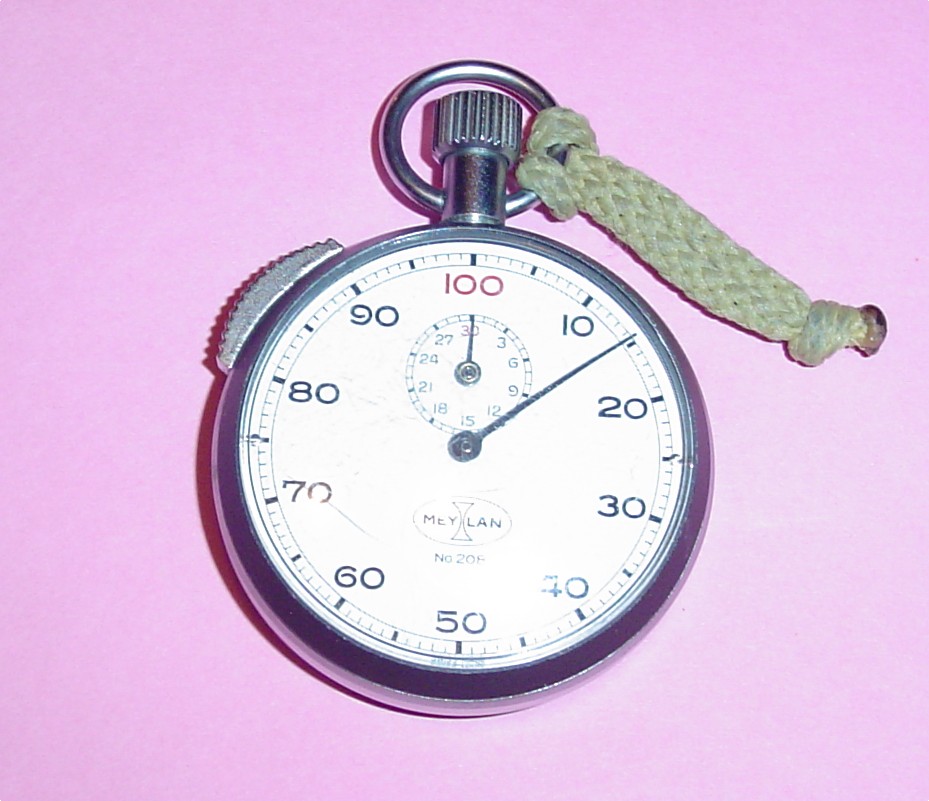
There are many helpful and simple lean tools to use on your lean journey however one tool stands out above all others. The basic stopwatch has proven itself to be the best lean tool available. Like a compass to a hiker, a stopwatch is to the lean practitioner.
The focus of lean manufacturing is to eliminate waste in your process and improve your value stream. The measurement of your success is found in your process timeline which is best measured with a stopwatch. Some might argue that a calendar is a better tool with some processes but I will save that point for another day.
What other tool is the best decision maker of a lean improvement where time is the key determining factor? A stopwatch is unbiased and simply tells you how much time an activity takes without playing favorites. In the past, I have found instances where people would spend hours arguing the merits of one method over another method. In most cases, either no decision could be agreed upon or one party gives up in frustration. A better approach is to put aside the power plays and let the stopwatch determine the best method. Instead of wasting time debating who's ideas is better, go to gemba and try both methods while the stopwatch measures the results. Let the stopwatch lead your way.
Helpful lean hint: Try to get in the habit of measuring time in seconds. If you use minutes or hours, people tend to think in those larger terms and believe 1 hour is quick. If you use seconds, it places emphasis on your lean journey that every second counts.
Thursday, March 02, 2006
Quality Plateau or Quality Ceiling?
There is an interesting quality article in today's issue of USA Today. The article is written by James R. Healey titled "Consumer Reports sees quality plateau". In the latest Consumer Reports testing and car owner surveys, the top reliability awards all go to Asian brands. In fact there are no Detroit models in the top 10. The top 10 are all Japanese brands.
That really did not come as a surprise to me based on past reports. But what surprised me the most were the comments by several individuals including Anne Stevens, COO of Ford Motors North and South American operations. These comment lead me to the conclusion that domestic car manufacturers, namely Ford, have already lost the battle against the Japanese manufacturers!
The biggest problem I have is the mental attitude that we are as good as we can get and that "it's impossible to manufacture a product as complex as a car or truck with zero defects". With this attitude at the top how the heck can they improve? I see the words of Ms. Stevens that despite the fact that they (Ford) "have reached a difficult level to break but that doesn't mean don't keep trying", but I sense that even she does not believe they can really get any better.
On top of that, Consumer Reports adds their opinion based on the results that "It could indicate that the most reliable new cars have reached a practical limit as to how trouble free they can become". Another opinion from Jim Hossacks, AutoPacific consultant, states that "the cost benefit ratio might have maxed out and improving much more would cost the manufacturer more that its worth. It might not be a technical issue but a practical, economic limit".
I believe that they are collectively selling out to the notion that we-are-as-good-as-we-can-get. They must not truly understand the power of continuous improvement and lean principles along with poka-yoke! Do you really think that Toyota is saying that they can not improve?
I love data so let look at some of the facts presented in this article. In 2002, the Japanese car manufacturers on average posted 15 problems per 100 new vehicles. In 2006, they improved to 12 problems per 100 new vehicles. That is a whopping 20% improvement! Over the same period, Detroit car manufacturers were stuck at 17 or 18 problems per 100 new vehicles. No improvement. WOW!
Sounds like Ford could reasonable expect to meet at minimum the Japanese level of four years ago (15 problems) for a roughly 16% improvement. It is possible! Mentally, you must accept the possibility to make it happen. That should be Ford's first target. No excuses, just make it happen.
As for zero defects, it is possible! Just like breaking the four minute mile barrier, for years it was universally believed that it was humanly impossible. After the barrier was broke, other runners started to run the mile in under four minutes soon after. The same goes for zero defects, the barrier will be broke and most likely by a Japanese car manufacturer.
That really did not come as a surprise to me based on past reports. But what surprised me the most were the comments by several individuals including Anne Stevens, COO of Ford Motors North and South American operations. These comment lead me to the conclusion that domestic car manufacturers, namely Ford, have already lost the battle against the Japanese manufacturers!
The biggest problem I have is the mental attitude that we are as good as we can get and that "it's impossible to manufacture a product as complex as a car or truck with zero defects". With this attitude at the top how the heck can they improve? I see the words of Ms. Stevens that despite the fact that they (Ford) "have reached a difficult level to break but that doesn't mean don't keep trying", but I sense that even she does not believe they can really get any better.
On top of that, Consumer Reports adds their opinion based on the results that "It could indicate that the most reliable new cars have reached a practical limit as to how trouble free they can become". Another opinion from Jim Hossacks, AutoPacific consultant, states that "the cost benefit ratio might have maxed out and improving much more would cost the manufacturer more that its worth. It might not be a technical issue but a practical, economic limit".
I believe that they are collectively selling out to the notion that we-are-as-good-as-we-can-get. They must not truly understand the power of continuous improvement and lean principles along with poka-yoke! Do you really think that Toyota is saying that they can not improve?
I love data so let look at some of the facts presented in this article. In 2002, the Japanese car manufacturers on average posted 15 problems per 100 new vehicles. In 2006, they improved to 12 problems per 100 new vehicles. That is a whopping 20% improvement! Over the same period, Detroit car manufacturers were stuck at 17 or 18 problems per 100 new vehicles. No improvement. WOW!
Sounds like Ford could reasonable expect to meet at minimum the Japanese level of four years ago (15 problems) for a roughly 16% improvement. It is possible! Mentally, you must accept the possibility to make it happen. That should be Ford's first target. No excuses, just make it happen.
As for zero defects, it is possible! Just like breaking the four minute mile barrier, for years it was universally believed that it was humanly impossible. After the barrier was broke, other runners started to run the mile in under four minutes soon after. The same goes for zero defects, the barrier will be broke and most likely by a Japanese car manufacturer.
Monday, February 27, 2006
Sears Quick Tool Change Replacement Muda
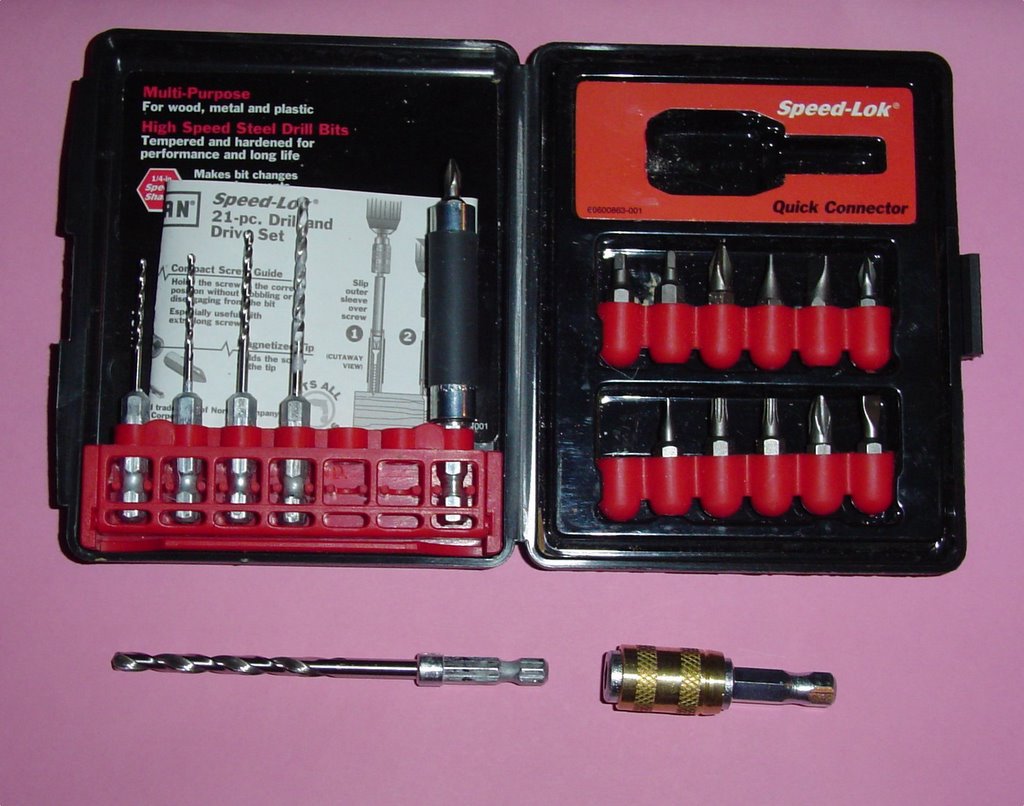
Sears has a cool quick tool change system in their Craftsman tool line called Speed Lok that has converted me from the old method of changing drill bits with a key. The Speed Lok system has a quick connection that allows for the quick change. It works great on projects where I need to drill a pilot hole first then easily change bits to screw in the boards.
From a lean manufacturing point of view, this is a nice quick change system. However, when it comes to getting a replacement bit, the Sears system has muda. All drill bits are considered perishable tooling with tool wear and breakage so there will come a time to replace a bit. This past weekend, in the middle of a project, my 5/32" bit broke.
I thought it would not be a problem to just replace it. It didn't turn out as easy as I originally thought. Apparently, my local Sears store does not carry individual bits of the Speed Lok system yet carried a wide selection of the old key method bits which could be bought individually. My only choice, if I wanted to stay with the Speed Lok, was to buy another set. The smallest set was 21 pieces. Why force a customer to buy 21 pieces when they only need 1 piece? MUDA!
Maybe a different Sears store carries individual bits but that would take me out of my way. Good thing the 21 piece set was on sale, I saved 50% of the cost. If I could have bought just the individual bit, I'm sure I could have saved even more.
Wednesday, February 22, 2006
The Sound of Manufacturing
In my recent post on the Top 5 Rules of Effective Measurement Boards, Rule #5 is to meet daily at the boards. And the best method is to go to gemba and meet directly on the shop floor in a manufacturing environment. As Rick Maher points out in his comment, they love their boards for their daily meeting however "we are unable/unwilling to hold our daily meeting at the boards because the noise of the plant is too loud and distracting". Their solution is to move the boards which are on casters to a conference room for their daily meeting. Any ideas?
The public image of manufacturing as a place of smoke stacked buildings that are dark, dreary, dirty, oily, smelly, and noisy is certainly a throwback to the old days. That is not say that all manufacturing plants are a Garden of Eden, but many improvements to the manufacturing environment have taken place over the years.
In a lean journey, a strong 5-S program helps dramatically improve the working environment of a manufacturing plant. In the past, dirt and poor light were an accepted condition because that is just the way it is in a manufacturing setting. With 5-S, we changed that way of thinking. Dirt, clutter and darkness are not allowed anymore. But what about noise?
Noise is probably the last area to conquer in manufacturing. Rick's plant is probably just like many of our plants. With all the bells blaring , towmotors revving , horns honking, metal slamming, intercom chattering, air compressors churning , air hoses hissing, motors running, skids dropping not to mention people yelling, music blaring, saws buzzing, belts turning, conveyors squeaking, hammers banging, welders buzzing, presses pounding, tools humming and fans turning. The problem is that we are conditioned to accept this noise level as just the way of manufacturing life.
Without knowing any details of Rick's plant, I will try to offer a few improvement ideas. First, decide that noise levels can be improved just like dirt and low lighting. Start by asking the 5 Whys to get at the root cause of noise. For example: towmotors make lots of noise, why? They have loud mufflers? Why? The mufflers have holes in them? Why? they have not been replaced? Why? Maintenance has not replaced them? Why? Not listed on a PM Program.
Now we can replace the mufflers and add them to the PM program.
If you pushed the lean principles, I would ask the questions from a different point of view. Why do we need towmotors in the first place? We move bulk stock around the plant. If we organized into cells with one piece flow, towmotors can be eliminated (or drastically reduced). One noise source eliminated. So try to eliminate it before reducing it.
The overall noise issue would be an excellent Kaizen event. Form a team to root out all the noise sources and eliminate or reduce them. A sound meter can be easily purchased for low cost to measure the before and after noise levels. Set a goal for an 80% reduction in one week.
Be creative in your approach with isolating noisy equipment with sound dampening panels and eliminating metal to metal contacts (use padding, carpet, foam, plastic, etc.). Use two-way communication systems instead of a plant wide intercom. Block the air compressor noise by isolating it or adding dampening panels. As you replace tools, make lower sound levels a desirable criteria in the selection process. Have a plant wide effort for noise reduction by fixing leaks, replacing hoses, and oiling squeaks. Are all the buzzers and bells still useful? Get rid of unneeded signals. Don't get in the habit of turning on all the equipment at the beginning of the shift when some equipment is not needed. Turn off these machines when not used regularly.
I hope these suggestions help in your lean journey and reduce the noise levels. If anybody has other suggestions or experiences with noise reduction efforts in their plants, please help us by adding them to our comments. Thank you Rick for presenting an outstanding challenge!
The public image of manufacturing as a place of smoke stacked buildings that are dark, dreary, dirty, oily, smelly, and noisy is certainly a throwback to the old days. That is not say that all manufacturing plants are a Garden of Eden, but many improvements to the manufacturing environment have taken place over the years.
In a lean journey, a strong 5-S program helps dramatically improve the working environment of a manufacturing plant. In the past, dirt and poor light were an accepted condition because that is just the way it is in a manufacturing setting. With 5-S, we changed that way of thinking. Dirt, clutter and darkness are not allowed anymore. But what about noise?
Noise is probably the last area to conquer in manufacturing. Rick's plant is probably just like many of our plants. With all the bells blaring , towmotors revving , horns honking, metal slamming, intercom chattering, air compressors churning , air hoses hissing, motors running, skids dropping not to mention people yelling, music blaring, saws buzzing, belts turning, conveyors squeaking, hammers banging, welders buzzing, presses pounding, tools humming and fans turning. The problem is that we are conditioned to accept this noise level as just the way of manufacturing life.
Without knowing any details of Rick's plant, I will try to offer a few improvement ideas. First, decide that noise levels can be improved just like dirt and low lighting. Start by asking the 5 Whys to get at the root cause of noise. For example: towmotors make lots of noise, why? They have loud mufflers? Why? The mufflers have holes in them? Why? they have not been replaced? Why? Maintenance has not replaced them? Why? Not listed on a PM Program.
Now we can replace the mufflers and add them to the PM program.
If you pushed the lean principles, I would ask the questions from a different point of view. Why do we need towmotors in the first place? We move bulk stock around the plant. If we organized into cells with one piece flow, towmotors can be eliminated (or drastically reduced). One noise source eliminated. So try to eliminate it before reducing it.
The overall noise issue would be an excellent Kaizen event. Form a team to root out all the noise sources and eliminate or reduce them. A sound meter can be easily purchased for low cost to measure the before and after noise levels. Set a goal for an 80% reduction in one week.
Be creative in your approach with isolating noisy equipment with sound dampening panels and eliminating metal to metal contacts (use padding, carpet, foam, plastic, etc.). Use two-way communication systems instead of a plant wide intercom. Block the air compressor noise by isolating it or adding dampening panels. As you replace tools, make lower sound levels a desirable criteria in the selection process. Have a plant wide effort for noise reduction by fixing leaks, replacing hoses, and oiling squeaks. Are all the buzzers and bells still useful? Get rid of unneeded signals. Don't get in the habit of turning on all the equipment at the beginning of the shift when some equipment is not needed. Turn off these machines when not used regularly.
I hope these suggestions help in your lean journey and reduce the noise levels. If anybody has other suggestions or experiences with noise reduction efforts in their plants, please help us by adding them to our comments. Thank you Rick for presenting an outstanding challenge!
Monday, February 20, 2006
Waste can Sometimes be Put to Good Use
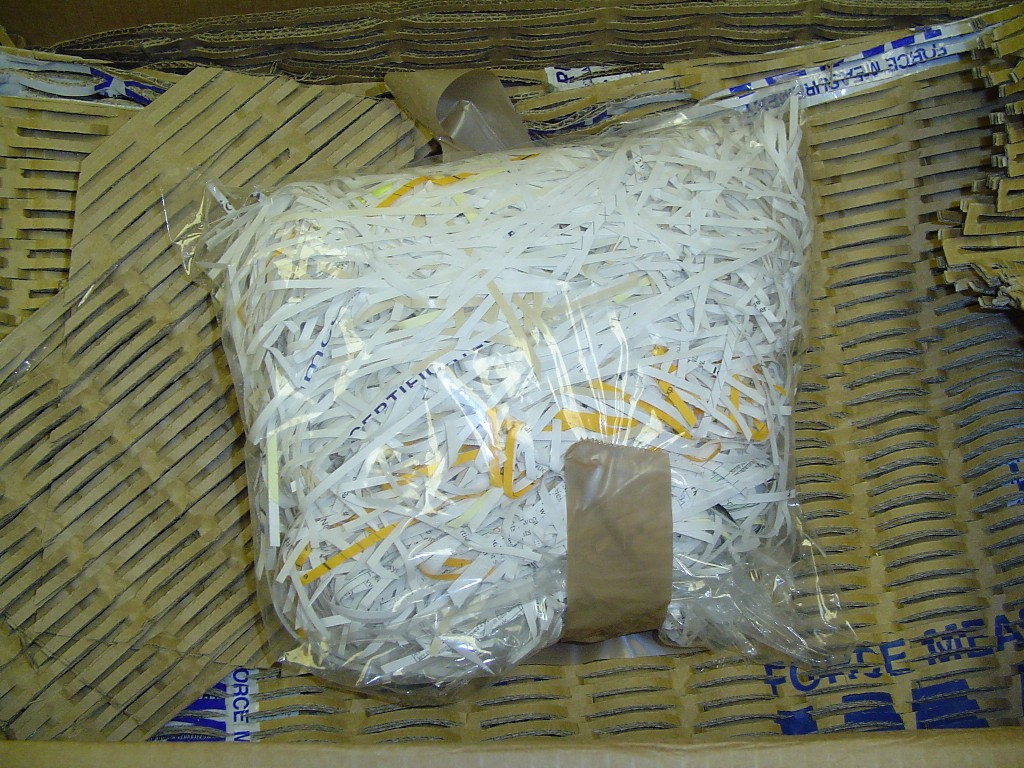
I promote the elimination of waste as one of the driving forces of lean manufacturing and I am not deviating from that objective. However, I saw a cool example of turning waste into a second, useful life.
This past week, I ordered an Imada force gauge and test stand from MSC Industrial Supply. My buying experience was outstanding. MSC arranged for a non-catalogue item (the specific test stand I wanted) directly shipped from Imada within two days. Instead of saying "Sorry, we don't carry it", they told me "Let me see what we can get from the manufacturer!". All over the phone it two minutes. Great Job MSC!
When the package arrived at the my dock door, I quickly got the packing slip passed on to purchasing and opened the box. The cool idea I saw inside was waste put to good use. A bundle of shredded office paper in a plastic bag was used as protective padding. What an excellent use of typical paper waste. Great idea Imada!
Friday, February 17, 2006
Point the Way on Charts on Graphs
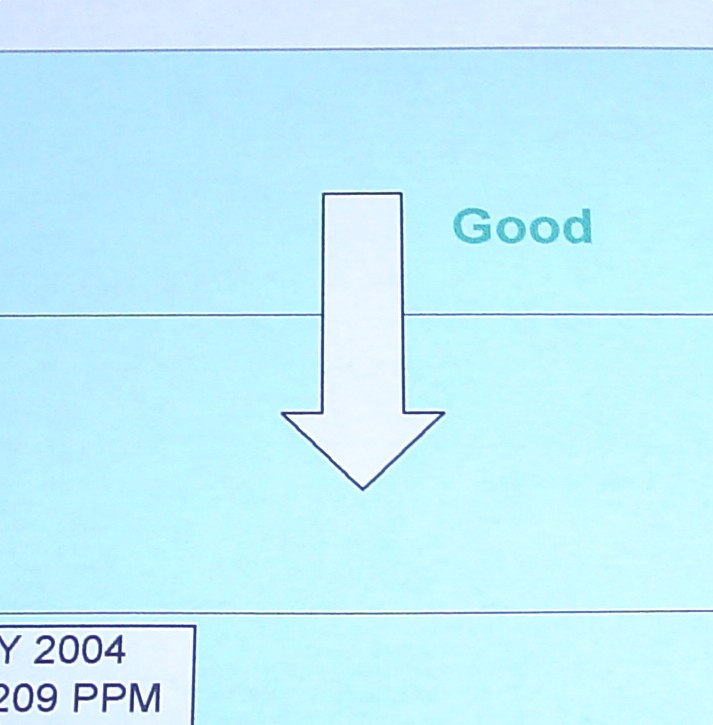
Here is a good idea I recommend for your charts and graphs on measurement boards - adding an arrow. This arrow will indicate the good direction of the chart. For example, a quality PPM goal will be positive if decreasing so the arrow will point down.
Many people may not understand how to read your charts at a quick glance. Some charts going up is good and other charts going down is the positive direction. It may be confusing which one is which on your chart. So make it easier for them! Add this little visual indicator and everyone will quickly see which direction is the positive one.
Wednesday, February 15, 2006
Top 5 Rules of Effective Measurement Boards
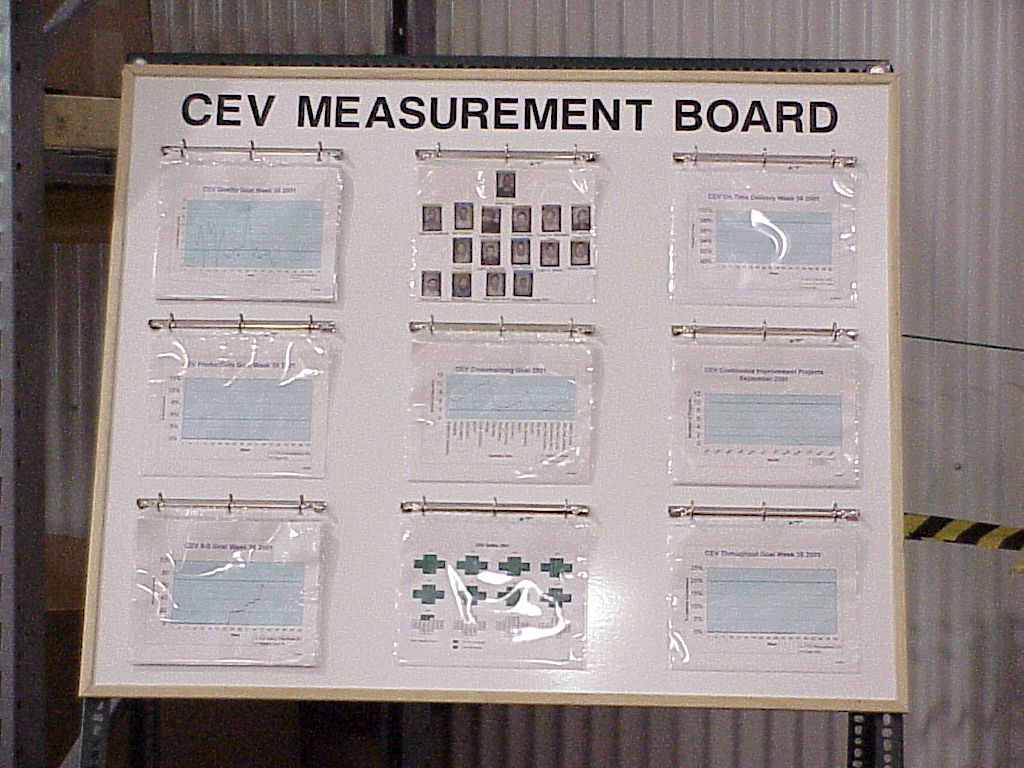
Keep everyone informed by using a department measurement board or dashboard listing the top metrics during your lean improvement journey. For measurement boards to be of any value, here are a few must do rules.
Rule #1 Board Information Must Always Be Current
To be effective, the board must be updated regularly with the latest information. Once the information becomes stale like an old bread loaf on the kitchen counter, it will be useless as an improvement tool.
Rule #2 Boards Display Only Most Important Metrics
When choosing metrics for a company, plant or department, the list grows fast to cover all the possible measures that management deems important to control a business. That's the wrong approach from the old way of "thinking". Remember, you are now "Lean Thinking". That means metrics should be specific to the goals of a lean thinking organization. Measure safety, Measure time (order to customer delivery to payment), Measure quality from the customer point of view (complaints and defect in Parts Per Million), Measure number of improvements, Measure the bottom line.
Rule #3 Promote the Team
The results of each metric is due to the diligence, creativity and basic roll-up-your-sleeves hard work by each team member of the area. Give them the credit for what the metrics display. Put their names and pictures out front for all to see.
Rule #4 Boards Show Future Action
It is important to show the metrics and achievements of the department on the board. Track progress, be proud of the accomplishments and recognize the team. But in reality, it looking at life through the rear view mirror. The measurement boards are also boards of action. List countermeasures, improvement action plans, people responsible and implementation dates. Emphasis should be towards the future on what we are planning to do in addition to the history lesson of what we have already accomplished.
Rule #5 Meet Daily at the Boards
As mentioned many times before, lean manufacturing principles strongly promotes going to gemba. Instead of a typical daily manufacturing staff meeting or production meeting held in the conference room, go around to each of the department board for the updates. Have the leader or even an individual team member update the group from the board. It will certainly promote the importance of the metrics for all to see and give others the chance to see improvements at gemba. Improvements can be seen in 3-D on the shop floor better than any paper report.
Monday, February 13, 2006
Needs a Good Home
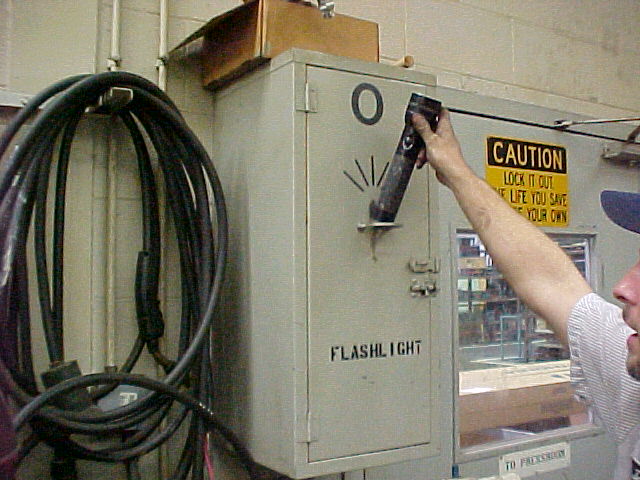
A place for everything and everything in its place is the motto of 5-S. The muda of searching for items and the added frustration after a lengthy hunt can be eliminated by following this principle. To follow this deceptively simple principle can be a challenge.
All it takes is organization (establishing a home), communication (letting everyone know where is home) and discipline ( putting it back after use). The hardest of the three is usually the discipline portion of the equation. We tend to let our bad behaviors and old habits get in the way of change. We can also rationalize that we will put it back later because something important just came up. With training, persistence, and following up, we can overcome these old habits. If you show that this is important, it will become important to others.
Thursday, February 09, 2006
Biggest Barrier in American Business Getting Lean
One of the most basic fundamentals in the lean approach to business is the single biggest barrier preventing the majority of business "getting it". It can be simply put just like the title of Jim Womack and Daniel Jones' book, it's all about "Lean Thinking".
As Dr. Shigeo Shingo stated, "much more than a matter of technique; it is an entirely new way of thinking about production itself". That's our problem. We don't think lean, we just use the tools..sometimes.
As Dr. Shigeo Shingo stated, "much more than a matter of technique; it is an entirely new way of thinking about production itself". That's our problem. We don't think lean, we just use the tools..sometimes.
Wednesday, February 08, 2006
Gas Tank Poka-Yoke

Have you ever been driving a rental car (or a car that you normally don't drive) when you pull into the gas station to fill up only to realize that you don't know which side of the car is the gas tank? In the past, you had a 50/50 chance of getting it right when you pulled up to the pump. After getting out of the car to check, you may have to pull back in on the other side...Definitely muda.
Here is a great example of a simple poka-yoke device that solves this problem. Look on the dashboard at the gas gauge. Most newer cars have added a simple arrow indicating the correct side of the vehicle to fill up the gas tank. Cool poka-yoke device, almost as good as the low gas indicator!
Tuesday, February 07, 2006
Signs don't always Work
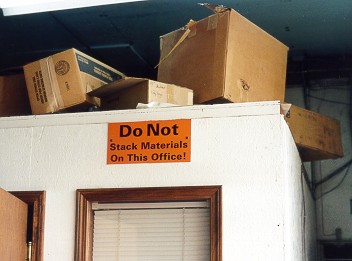
Signs have been a common method to communicate information since the beginning of the written word. Unfortunately, we don't always follow the instructions as seen in this actual plant photo. I wonder why this particular sign did not cause people to follow it's directive? Many times we think by just putting a sign up will solve or prevent a problem. Think again!
Should we track down the offenders and make public examples of their civil disobedience. Verbal warning, written warning, double secret probation or just fire them? Some management would think along these lines.
Wouldn't it be a better approach to poka-yoke (mistake proof) the situation. Putting this lean principle into action, maybe a sloped roof would prevent this problem. Are there places within your work environment where signs are ignored too? Take a moment to see if a better approach can be put into action.
Monday, January 30, 2006
Can you Read the Handwriting on the Wall?
Regardless of what productivity improvement method you subscribe, the area of communication always shows up on the list as a much needed area of improvement. As humans, we have struggled with this problem since the beginning of time without significant results (with the exception of speed and distance). From the earliest cave drawings to hieroglyphics to the written word, people have expressed their ideas, thoughts and instructions to others yet many times there is a breakdown in conveying the message. Knowing this, why not take every opportunity to prevent the muda of poor communication or miscommunication?
From a lean manufacturing point of view, the muda associated with poor communication causes, at minimum, a stumbling block in the value stream all the way up to a major disaster that could jeopardize the survival of the company. Sometimes the mistakes in communication create a humorous event with little harm to the organization (the best kind of communication error if there is one).
One of the earliest and most common methods of communication is writing. Of course, the earliest form was the handwriting on the wall (of the cave). Even today, the skill in reading the handwriting on the wall helps in the business world. But that depends a lot on the quality of penmanship. Unfortunately, many of us have poor penmanship. Our 7 could look like a 1 or 9. Our 6 could be mistaken for a zero. Words like kick, lick, nice and kiss get confused and cause problems...Just ask Guy Kawasaki.
Quite a few years ago, before the PC could be found on every desktop, our computer system at Hill-Rom (one of my previous employers) was housed in the large, central computer room. In order to add, delete or modify any computer records, engineers had to submit a transmittal. A transmittal was a simple formatted sheet of paper with designated spaces to hand write the information of the record that was given to computer programmers for entry. I was adding some work centers to our MRP system for the fabrication department and one of these work centers was for a 105 ton punch press. Keeping with our naming convention, I wrote 105T Press on the transmittal sheet. After waiting on the batch process (3 days back then) to clear, I received confirmation of my new work center. The only problem, my 105T Press was added as the Lost Press. That error did not cause a lot of harm but certainly was the source of many wisecracks. Every time I walked through the fab department, somebody would shout out, "Hey, Mike. Did you ever find that press we were missing?"
By avoiding handwritten communication and using computers, label makers or printed out forms of communication wherever possible, you can improve you chances of getting your message across. Look around your office and factories at all the handwritten information posted. Can you read the handwriting on the wall?
From a lean manufacturing point of view, the muda associated with poor communication causes, at minimum, a stumbling block in the value stream all the way up to a major disaster that could jeopardize the survival of the company. Sometimes the mistakes in communication create a humorous event with little harm to the organization (the best kind of communication error if there is one).
One of the earliest and most common methods of communication is writing. Of course, the earliest form was the handwriting on the wall (of the cave). Even today, the skill in reading the handwriting on the wall helps in the business world. But that depends a lot on the quality of penmanship. Unfortunately, many of us have poor penmanship. Our 7 could look like a 1 or 9. Our 6 could be mistaken for a zero. Words like kick, lick, nice and kiss get confused and cause problems...Just ask Guy Kawasaki.
Quite a few years ago, before the PC could be found on every desktop, our computer system at Hill-Rom (one of my previous employers) was housed in the large, central computer room. In order to add, delete or modify any computer records, engineers had to submit a transmittal. A transmittal was a simple formatted sheet of paper with designated spaces to hand write the information of the record that was given to computer programmers for entry. I was adding some work centers to our MRP system for the fabrication department and one of these work centers was for a 105 ton punch press. Keeping with our naming convention, I wrote 105T Press on the transmittal sheet. After waiting on the batch process (3 days back then) to clear, I received confirmation of my new work center. The only problem, my 105T Press was added as the Lost Press. That error did not cause a lot of harm but certainly was the source of many wisecracks. Every time I walked through the fab department, somebody would shout out, "Hey, Mike. Did you ever find that press we were missing?"
By avoiding handwritten communication and using computers, label makers or printed out forms of communication wherever possible, you can improve you chances of getting your message across. Look around your office and factories at all the handwritten information posted. Can you read the handwriting on the wall?
Wednesday, January 25, 2006
Good Luck To Ford
With great interest, I have followed the latest drama of the Big Three ( now known as the Shrinking Three) . The turnaround plans recently announced with great fanfare by Mr. Bill Ford were not surprising-cut jobs, close plants and squeeze suppliers. Sure there were faint glimpses of hopeful vision thrown in the plan about doing business with a focus on innovation and changing the business as usual culture.
My initial reaction to the plan was neutral. That's the problem, no excitement and no rally cry to gather around. Based on their plan, my belief is that Ford will not regain the market share its lost over the years of molasses management however Ford will survive. (Smaller but still kicking). Basically, I have little faith that Ford's culture can really change. As a Pro-American Manufacturing professional(and Ford owner), I hope that I am wrong and I wish Ford the best of luck!
If Ford is seriously wanting to challenge "Business as Usual" and reverse their downward spiral, here are a few suggestions. (Same goes for GM, since I'm also a Buick owner).
1. Upper Management is to accept responsibility for the current condition of their company. Look inward at their decisions and policies instead of blaming everybody and everything else. The first reorganization should be in the top tiers, not at the hourly level.
2. Forget about the practice of hiring management with "automotive experience only" requirements. Ford needs to hire based on talent. Get the best talent available from anywhere you can find it.
3. Forget about cutting costs. Instead focus on eliminating waste and adding value from the customers point of view. Profits will follow. If Ford management does not understand the difference or what this means, there is no hope for a true culture change.
4. Put manufacturing people in charge. Its all about the cars and trucks. Listening to finance and accounting may help in number crunching but the passion is in the product.
5. Be humble and seek knowledge from examples of Toyota and Honda. Learn the ways to improve and make it fit within the "new" culture of Ford.
6. Kill the current overpriced ad campaigns-they do not work. Slash the ad budget by 90% and cut all the different ads for all the different models. Replace the ads with ONE powerful, central theme of a simple message. The spot would feature Mr. Bill Ford talking to America by simply saying Ford is changing for you (the American Car buyers) featuring improved style, performance and safety. Let us prove it to you and you be the judge. Short, simple and run only a fraction of the times. The print ads should be the exact same message. One message, one ad concept to sell Ford not each model.
7. The main problem is not over capacity, it is overhead. Keep the factories and adjust the overhead cost to match volume.
Finally, to improve you must go to gemba! I wonder if Mr. Ford has personally visited any of the 14 proposed plants set for closure/idle or the decisions were based on reports/presentation data? Shame on any senior management that fails to regularly visit their own manufacturing plants especially if they are contemplating closing one down.You can not improve or make solid decisions from afar, roll up your sleeve and go to gemba to gain awareness and true understanding.
My initial reaction to the plan was neutral. That's the problem, no excitement and no rally cry to gather around. Based on their plan, my belief is that Ford will not regain the market share its lost over the years of molasses management however Ford will survive. (Smaller but still kicking). Basically, I have little faith that Ford's culture can really change. As a Pro-American Manufacturing professional(and Ford owner), I hope that I am wrong and I wish Ford the best of luck!
If Ford is seriously wanting to challenge "Business as Usual" and reverse their downward spiral, here are a few suggestions. (Same goes for GM, since I'm also a Buick owner).
1. Upper Management is to accept responsibility for the current condition of their company. Look inward at their decisions and policies instead of blaming everybody and everything else. The first reorganization should be in the top tiers, not at the hourly level.
2. Forget about the practice of hiring management with "automotive experience only" requirements. Ford needs to hire based on talent. Get the best talent available from anywhere you can find it.
3. Forget about cutting costs. Instead focus on eliminating waste and adding value from the customers point of view. Profits will follow. If Ford management does not understand the difference or what this means, there is no hope for a true culture change.
4. Put manufacturing people in charge. Its all about the cars and trucks. Listening to finance and accounting may help in number crunching but the passion is in the product.
5. Be humble and seek knowledge from examples of Toyota and Honda. Learn the ways to improve and make it fit within the "new" culture of Ford.
6. Kill the current overpriced ad campaigns-they do not work. Slash the ad budget by 90% and cut all the different ads for all the different models. Replace the ads with ONE powerful, central theme of a simple message. The spot would feature Mr. Bill Ford talking to America by simply saying Ford is changing for you (the American Car buyers) featuring improved style, performance and safety. Let us prove it to you and you be the judge. Short, simple and run only a fraction of the times. The print ads should be the exact same message. One message, one ad concept to sell Ford not each model.
7. The main problem is not over capacity, it is overhead. Keep the factories and adjust the overhead cost to match volume.
Finally, to improve you must go to gemba! I wonder if Mr. Ford has personally visited any of the 14 proposed plants set for closure/idle or the decisions were based on reports/presentation data? Shame on any senior management that fails to regularly visit their own manufacturing plants especially if they are contemplating closing one down.You can not improve or make solid decisions from afar, roll up your sleeve and go to gemba to gain awareness and true understanding.
Monday, January 23, 2006
Spend More Time at Gemba
When I was visiting a customer site recently, a passing comment by my customer hit a nerve. He told me that this was the first time anyone from my company spent more that one or two hours at his distribution center. My visit (my first to this customer) was for two straight days trying the learn all I could on how our products were received and the quality level of our products. In addition, I listened to everything my customer had to say about our products and service to improve.
His comment hit a nerve in that we sometimes take our customers for granted and sometimes not take the time to "see" the issues from our customer point of view. It also got me thinking about "Going to Gemba" principle of lean manufacturing.
I bet that all the previous visitors thought just a quick visit to see "how things were going" was enough time to spend at gemba. So how much time should one spend at gemba? Is one or two hours enough?
According to the stories I was told about gemba training, Taiichi Ohno was famous for taking engineers or supervisors to the plant floor and making them stand in a circle on the floor to observe the process. After a while (usually several hours), Taiichi Ohno would ask them questions about the process. If the answers proved unsatisfactory, it was back to the circle. Sometimes this observation period would last a full 8 hours shift.
The point is to stay at gemba until you understand the process clearly or gain awareness. In my case, two days were enough time to understand my customers process. It will take more time in gemba to truly gain awareness.
His comment hit a nerve in that we sometimes take our customers for granted and sometimes not take the time to "see" the issues from our customer point of view. It also got me thinking about "Going to Gemba" principle of lean manufacturing.
I bet that all the previous visitors thought just a quick visit to see "how things were going" was enough time to spend at gemba. So how much time should one spend at gemba? Is one or two hours enough?
According to the stories I was told about gemba training, Taiichi Ohno was famous for taking engineers or supervisors to the plant floor and making them stand in a circle on the floor to observe the process. After a while (usually several hours), Taiichi Ohno would ask them questions about the process. If the answers proved unsatisfactory, it was back to the circle. Sometimes this observation period would last a full 8 hours shift.
The point is to stay at gemba until you understand the process clearly or gain awareness. In my case, two days were enough time to understand my customers process. It will take more time in gemba to truly gain awareness.
Thursday, January 19, 2006
Quest for the Dawn
For the past couple of months I have been on the road more than usual. Although it keeps me away from my family, it does have a side benefit of allowing for some quality reading time at night. There are a stack of books held in reserve for just this purpose.
A book that I recently finished is "Quest for the Dawn" by Shoji Kimoto. "Quest for the Dawn" is a fascinating true story set from about 1930 to the mid 1950s of a bold business quest to build an automobile from the ground up. The relentless inventors were Sakichi and Kiichiro Toyoda and, of course, the car manufacturer was the Toyota Motor Company.
Based on translations from their personal diaries, this story provides a powerful insight on the determination, vision and passion of the founders that built Toyota. It also gives a glimpse of the Just-in-Time philosophy that started from day one at Toyota and formed the groundwork of the modern Toyota Production System.
If you have the opportunity, pick up a copy of Quest for the Dawn. It is definitely worth the time to read. It is truly amazing that Toyota made it through their constant struggle to survive during those early years. In contrast to a large number of American companies with greed, short-term driven results and weak strategic direction, Toyota's culture is most honorable. The overwhelming factor in Toyota's success was passion, the key ingredient that is missing in many companies today.
A book that I recently finished is "Quest for the Dawn" by Shoji Kimoto. "Quest for the Dawn" is a fascinating true story set from about 1930 to the mid 1950s of a bold business quest to build an automobile from the ground up. The relentless inventors were Sakichi and Kiichiro Toyoda and, of course, the car manufacturer was the Toyota Motor Company.
Based on translations from their personal diaries, this story provides a powerful insight on the determination, vision and passion of the founders that built Toyota. It also gives a glimpse of the Just-in-Time philosophy that started from day one at Toyota and formed the groundwork of the modern Toyota Production System.
If you have the opportunity, pick up a copy of Quest for the Dawn. It is definitely worth the time to read. It is truly amazing that Toyota made it through their constant struggle to survive during those early years. In contrast to a large number of American companies with greed, short-term driven results and weak strategic direction, Toyota's culture is most honorable. The overwhelming factor in Toyota's success was passion, the key ingredient that is missing in many companies today.
Thursday, January 12, 2006
Reducing Process Variation, Just Be Consistent
The Six Sigma Approach to process improvement is holding steady across manufacturing and spreading into other areas like health care and the governmental sectors with some limited success. Unfortunately, many leaders are still in the dark about Six Sigma. (I can not tell you how many people still think my Black Belt is martial arts related).
The best way I found to get others to start to understand the Six Sigma Approach is to lay out the simple goal of reducing process variation or just be consistent.
Since not all processes are perfect, variation occurs. By tracking results or outcomes of a process, we can measure the limits of this variation. This will show us the behavior of the process. Based on the process behavior, we establish expectations from our process and we can predict future results. Then we can match the process results with customer expectations (process specifications). If they do not match or stay consistent, we have a big problem.
A good example is McDonalds' french fries. McDonalds does a pretty good job of controlling their french fry process so no matter what McDonalds you go to, the customer knows what to expect when they order french fries. The same can be said for most of their other food offerings. McDonalds is not perfect but they definitely understand the importance of the consistent quality of their product.
On the other end, Holiday Inn could take some simple lessons from McDonalds. This past week, for example, I was in Kansas City at a customer site with accommodations at Holiday Inn. Besides the check in and check out processes, very little service contacts are present to make a good impression on your hotel stay. One very simple process is having a USA Today placed outside your door each morning. During my stay, the paper was placed at my door only 2 out of 3 days. If I wanted a copy of the paper on the off morning, I had to go to the front desk.
Why is the simple process of having the paper at my door not consistent every morning? This inconsistent newspaper process happens no matter which Holiday Inn I might stay at (To be fair to Holiday Inn, other hotels have similar inconsistency with the newspaper delivery). You would think this morning newspaper delivery process would be easy to control. As a customer, I do not expect to see the paper every morning, it is a hit or miss process.
Based on the two examples, which process is more consistent? How does this consistency translate to satisfying the customer expectations? Using a Six Sigma approach helps you just be consistent to improve customer satisfaction.
The best way I found to get others to start to understand the Six Sigma Approach is to lay out the simple goal of reducing process variation or just be consistent.
Since not all processes are perfect, variation occurs. By tracking results or outcomes of a process, we can measure the limits of this variation. This will show us the behavior of the process. Based on the process behavior, we establish expectations from our process and we can predict future results. Then we can match the process results with customer expectations (process specifications). If they do not match or stay consistent, we have a big problem.
A good example is McDonalds' french fries. McDonalds does a pretty good job of controlling their french fry process so no matter what McDonalds you go to, the customer knows what to expect when they order french fries. The same can be said for most of their other food offerings. McDonalds is not perfect but they definitely understand the importance of the consistent quality of their product.
On the other end, Holiday Inn could take some simple lessons from McDonalds. This past week, for example, I was in Kansas City at a customer site with accommodations at Holiday Inn. Besides the check in and check out processes, very little service contacts are present to make a good impression on your hotel stay. One very simple process is having a USA Today placed outside your door each morning. During my stay, the paper was placed at my door only 2 out of 3 days. If I wanted a copy of the paper on the off morning, I had to go to the front desk.
Why is the simple process of having the paper at my door not consistent every morning? This inconsistent newspaper process happens no matter which Holiday Inn I might stay at (To be fair to Holiday Inn, other hotels have similar inconsistency with the newspaper delivery). You would think this morning newspaper delivery process would be easy to control. As a customer, I do not expect to see the paper every morning, it is a hit or miss process.
Based on the two examples, which process is more consistent? How does this consistency translate to satisfying the customer expectations? Using a Six Sigma approach helps you just be consistent to improve customer satisfaction.
Subscribe to:
Posts (Atom)