Wednesday, December 28, 2005

Kaizen for the Holiday Season


As I enjoyed the warmth of holiday time with my family, several ideas came to mind that could help improve the holiday season from the customer point of view. Although these ideas do not reflect upon the true meaning of the celebration of Christmas, they do provide a kaizen approach to the more commercial side of the holidays. I readily admit that these areas of improvement are purely self-centered in nature and, compared to world peace, are not all together important yet would go a long way to make our holidays just a little bit better. With that said, let me share my number one area of holiday improvement.

Improvement Ideas Number 1: Make all toys easy to open by kids.
Listen up Toy Manufacturers! Please get rid of those pain in the bottom twisted wires that hold many toys in their packages.

My nine year old daughter and soon-to-be five year old son are fiercely independent kids who want to open up their presents without adult assistance. Despite all the potential reasons by the toy manufactures for including these barriers to the true end customer (kids) to quickly get at their toy, the dreaded wires are hated by all.

I am not a toy manufacturing expert so the reasons of security, presentation and protection of these bound up toys may have some merit. But from my lean manufacturing experience and more importantly, my consumer experience, I believe that there must be a better way.

The manufacturing process to apply those twisted ties must be a labor intensive process not to mention extra material cost. Despite the fact that overall labor costs are low with a majority of these toys manufactured in China, the margins are tight in the competitive toy market. In addition, retail pressures from the big box retailers like Walmart, a big player in retail toy sales, will continue to squeeze out every penny in cost. Bottom line, there is an opportunity here to make customers happy and save costs.

While manufactures are looking at kid friendly packaging, lets look at replacing thick wires ties, not sewing Barbie's hair to the cardboard backing, pre-applying the tons of stickers that require adult application, and getting rid of the hard to remove security tapes on DVD cases. Each of these packaging methods are barriers for kids to getting straight to the action of playing with their new toys.

Christmas Holiday Wish

Christmas is a glorious season of renewed hope and joy for all mankind. May this spirit of peace and goodwill continue to burn bright within each of us throughout the New Year.

Wednesday, December 21, 2005

Keep Footprints Square


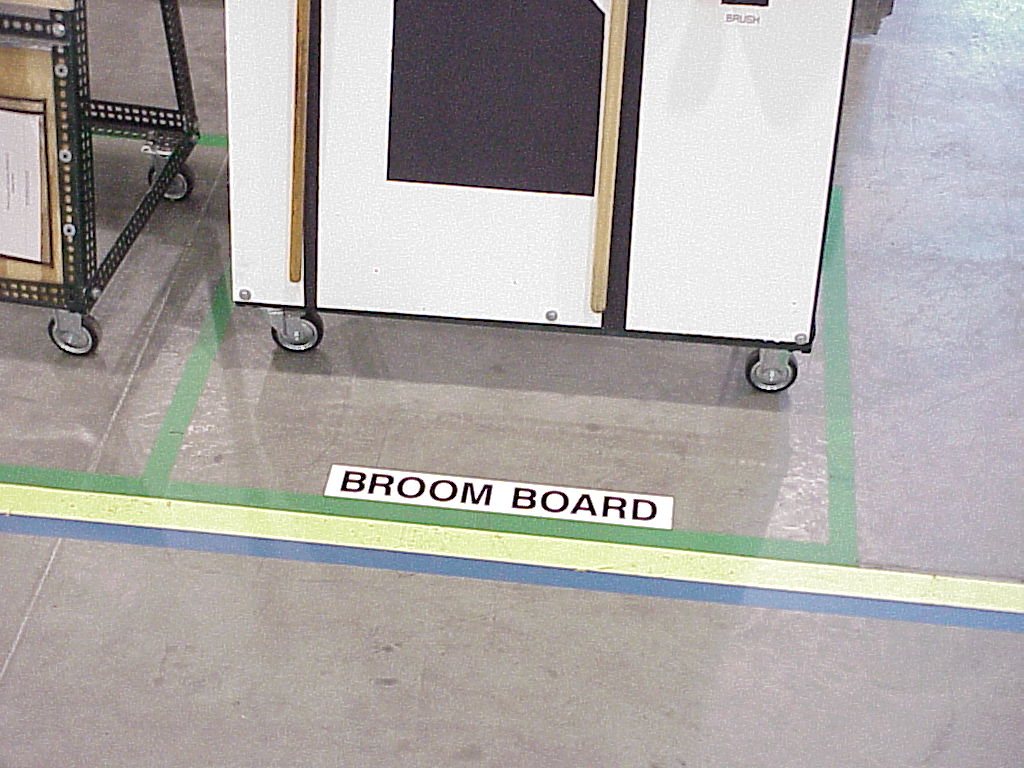
Placing footprints on the floor outlines the home of an item. This item could be equipment, tools, benches, boards, etc. Using simple floor tape and adding a name label makes it easy to identify the item belonging in the footprint.

A common mistake is to make a detailed outline the conforms to the item shape where the footprint ends up looking like a jigsaw puzzle piece. Don't spend excessive time and energy with this approach. A simple square or rectangle works best.

Tuesday, December 20, 2005

Door Arc


At first, it may sound a little silly. However, adding the footprint to a door arc makes perfect 5-S sense. With the aid of the visual door arc, everyone can see the area required for the free swing of the door. The area stays clear of obstructions and reduces the opportunity of accidents. Windows in doors help with visibility too.

Thursday, December 15, 2005

Call in the Experts, Ask your Employees

In the middle of a product comparison this morning, our management team quickly came to the conclusion that our product was second. The reaction of management seeing that a competing product was better than ours included disbelief, disappointment, surprise and fear. The fear probably motivated us the most. We did not waste any time arguing if we had a problem or not but unanimously agreed that we needed help. We needed experts so we decided to asked our employees.

The distinguishing feature that made our product lose out was our paint finish. There was some discussion by the team to call our paint supplier (expanding the team) but we did not want to delay a week in order to get them to the plant. Including your suppliers is an excellent idea and we will set that up however we wanted to start improving today.

Employees are the best sources of collective knowledge of your processes. Our painters are the in-house experts best able to improve our paint finish. A few hours later, we called a 1/2 hour meeting of the entire paint department. After seeing for themselves the side by side comparison of the products, a group discussion on the issue led to creating a fish bone diagram on the challenge. A simple statement, "What do you need to improve our paint finish?" focused the painters on improvement ideas.

Within 15 minutes, we had list of 23 outstanding improvements based on their knowledge of our processes. The painters decided which of their ideas are the top 3 that could help them the most to achieve a better paint finish. With management in the room, giving the nod of approval on the improvements, our direction was set.

The coolest part was seeing employees and management working together to solve a problem. The excitement and energy was intense as we openly talked together without reservations or animosity. This is what American business should be like everyday!

Monday, December 12, 2005

SME Article on Visual Work Instructions

I just received my copy of the SME e-Newsletter of Lean Manufacturing called Lean Directions which had an outstanding article on Visual Work Instructions. Most of the time, articles I read on lean are long on fluff and short on substance. This article has some excellent detailed points aimed at the lean practitioner.

Check out Dr. Steven Blackwell's article "Shorter Text for Visual Work Instructions". It follows the same concepts I have written about on making documents shorter, concise and to the point to improve use and understanding (ref posts "Visual Work Instructions Basics" and "When it Comes to Standard Work Instruction Computer Files, Size Matters" and "Make Every Word Count in Quality").

Great guidelines to create better visual work instructions like sentence structure and making it simple!

While at this site, just sign up for a free subscription to SME's Lean Directions. It's a great Lean Resource.

Saturday, December 10, 2005

Information Supply Chain Kaizen

Did you ever play this communication game in school or maybe at some training session? The game is where one person whispers a message in another person's ear then that person passes it on to the next person. This message continues to be passed one by one until it reaches the last person. The last person would say out loud the message which turns out to be very different from the original message. Hearing the final version of the message is usually humorous, entertaining and unnerving for the group. It is amazing how a simple message becomes radically altered as it gets passed through the chain.

Even though it is just a game, it does reflects the real challenges that businesses face in their information supply chain. When the term supply chain is used in business, we normally think of material flow. Material is passed on from supplier to supplier in what becomes a linked chain. Information can follow a similar path, from person to person in a linked supply chain. This information supply chain, like any other process in manufacturing, can be and should be an area for kaizen.

Many businesses on their lean journey have started with value stream mapping of their current state and go on to create their future state. In their value stream map, the operational process flow is detailed including inventory levels at each step. Beyond just the material flow, properly created value stream maps will include the flow of information.

Accurate and timely information is critical to the success of all businesses. All our decisions are based on the quality of our information. Ignoring the information supply chain can quickly erode any improvement gains in the physical processes. How many physical processes are improved but end up waiting on the information supply chain to catch up? I wonder if GM or Delphi in their lean activities ever looked at their information supply chain?

The same goes for working in a project environment where information is a primary driver of the activities within team. By improving the flow of information, many wastes can be eliminated and the timeline from project start to finish can be shortened. How many times have you worked on a project where team members or management did not keep pace with current events and valuable time was spent on getting everybody back up to speed?

Bottom line, information flow is critical in business yet not usually considered an area for kaizen. I consider it a hidden area of opportunity that when improved will create dramatic results for your business. Just like in the communication game, information passed through your organization can be radically altered. By applying the principles of Kaizen to your information supply chain, your information will be more accurate and timely.

Thursday, December 08, 2005

Do you Read Instructions Carefully Before Assembly?


I have come to the conclusion that there are two types of people in this world, ones that open a box and read the instructions carefully before assembly and the others that assemble first without looking at the instructions unless a major problem occurs. Even though I am a pretty good engineer, I always read the instructions first. My wife happens to fall in with the other crowd.

During this holiday season, many parents will be purchasing gifts that have in small print "some assembly required"on the box. Without exception, many of us will be burning the midnight oil in a frantic attempt to complete the task of assembly before Christmas morning. In those late night sessions, assembly problems can quickly add frustration regardless if you read instructions first or not. Although I really believe that reading the instructions first significantly lowers the chance of an assembly error.

Do you read instructions carefully before assembly? Good manufacturers will recognize that there exists in our world this great divide between the instruction readers and the intuitive assemblers. Great manufacturers will put a system in place to prevent operator errors for both groups.

So what is a manufacturer to do in order to prevent operator errors? An excellent lean tool quickly comes to mind called Poka-Yoke. Poka-Yoke is a system or device that prevents errors before they become problems. It is also known as error proofing or mistake proofing.

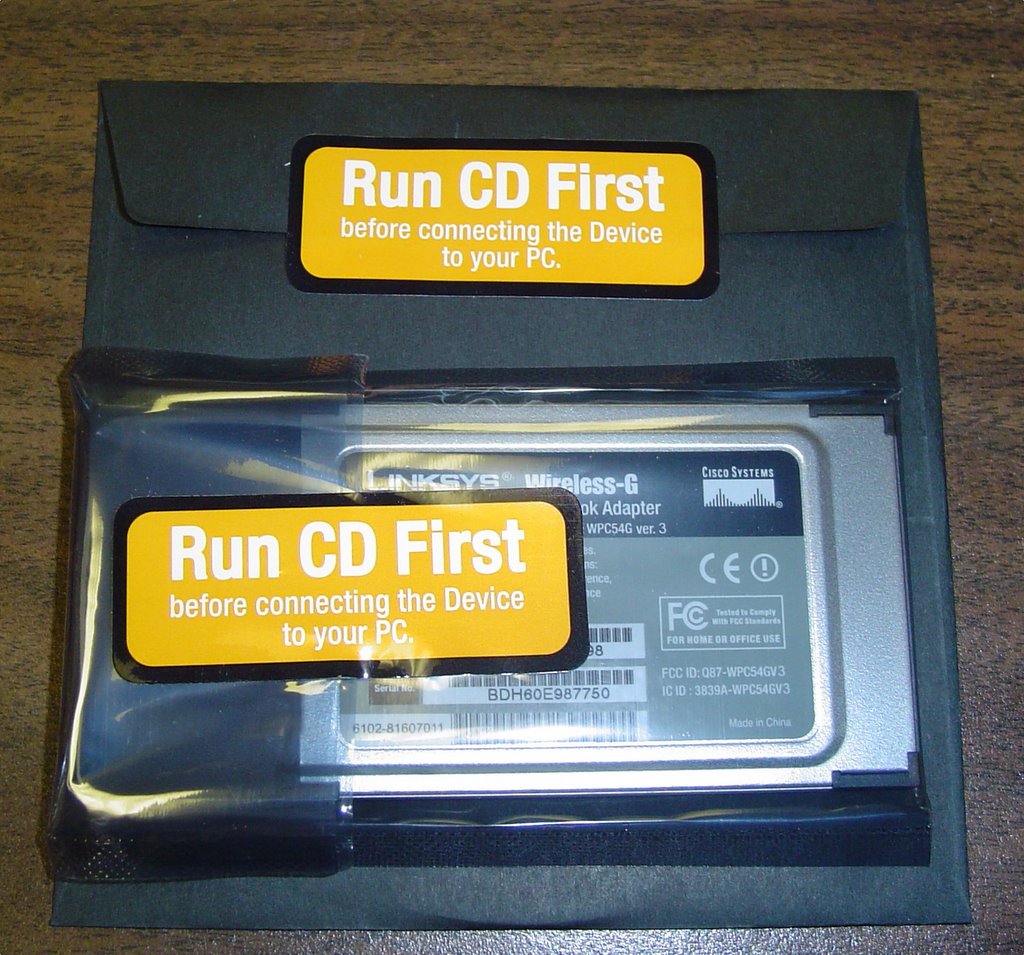
I came across an excellent example of a simple poka-yoke recently when I purchased a wireless card for my laptop. Yes, I am just now moving to wireless. Following the Toyota way of only going to proven technology, I have resisted earlier temptations to go wireless.

I purchased a wireless card from Linksys, a division of Cisco Systems. In bold letters, the first instruction on the instruction sheet clearly points out to run the CD first before connecting the device to your PC. The poka-yoke system Cisco Systems used to prevent an operator error in this step is a simple label. Knowing that some people never read the instructions first, they placed this label with the same warning to run the CD first on both the CD and the wireless card. As a result, no matter what I picked up first, I see this important instruction. I bet this simple poka-yoke has dramatically reduced, if not eliminated, the error of not running the CD first. Outstanding job Cisco!

Look at your processes and products. How can operator errors occur? Think how a simple poka-yoke can eliminate the error and make it mistake proof like Cisco Systems.

Tuesday, December 06, 2005

Eye Plugs Required

Nobody is perfect in this world and that goes for me too. Even in my quest for perfection based on the Toyota way, things sometimes get off track. I was reviewing and updating some quality inspection work instructions recently when I noticed something odd.

In our work instructions, we include safety notes and required PPE (Personal Protective Equipment) to perform the job safely. I even found some cool icons to add to give it a visual boost. After the edit was complete, a quick spell check was ran to double check for errors. So far, nothing out of the ordinary.

Then I saw it, plain as day. Under the icon I used for ear plugs, I accidentally typed in eye plugs. So much for spell check. To make matters worse, this work instruction was for the inspection process. (I bet if you asked some of our customers, they would agree that eye plugs were used in the past and on more than one occasion).

We had a good laugh over this mistake and made some fast corrections before it was released. Spell check works great in many cases. However, a second set of eyes would have probably seen the error because I obviously was wearing my eye plugs.

Sunday, December 04, 2005

Principle of Lean Genchi Genbutsu Can Go Beyond your Plant Walls

A key principle of lean manufacturing is genchi genbutsu which means to go and see at the actual place. Only by going to the actual place or source can we begin to understand the real facts of any situation. With this clear understanding, real improvement can be implemented.

Sometimes, the actual place is not within the four corners of your plant and you must look beyond your plant walls. I am talking about going to your supplier's location or even going to your supplier's supplier location.

This goes hand in hand with another key principle of lean which is to extend help to your partners and suppliers to improve. This extension of your continuous improvement efforts beyond your plant walls to your supplier helps everybody get better.

We applied both of these principles last week when faced with a quality issue from one of our suppliers. Instead of sending a typically SCAR (Supplier Corrective Action Request) for our supplier to respond with their fix or calling them to the carpet and pounding on them to get it right or else, we decided to extend our helping hand. There were no threats or heavy handed tactics that are common in American business today in our supplier relationships especially when problems hit the fan. Just a road trip to genchi genbutsu.

Most suppliers are apprehensive about a visit under these circumstances because of a basic lack of trust. How can you blame them? They expect the customer to jump all over them and in some case it is not without cause. But does this help solve the problem or follow the Toyota Way?

In our quest to solve the problem, we included visits to both our suppliers site and our supplier's supplier site to drill down to the root cause. With all parties working as one cooperative group, we were able to isolate the potential root cause and set up verification process plans to confirm the cause. In addition, quality procedures were strengthened to improve corrective and preventive actions. This including sharing our best practices, forms and procedures with our suppliers.

It was amazing to see the results. Next time you have a supplier problem, try the genchi genbutsu approach beyond your plant walls. Build trust and extend your helping hand.

Monday, November 28, 2005

Go Inch Wide and Mile Deep

The lean journey is not a short easy trip. It takes years of effort in the relentless pursuit of continuous improvement. One of the best pieces of advice given to me was to approach the lean journey by going inch wide and mile deep.

As you learn all the different kaizen tools and see the vast opportunities to eliminate waste, it can be exciting and overwhelming at the same time. You may be tempted to jump into the water and start swimming as fast as you can only to find the you are just treading water.

Don't try to apply all the different techniques across the entire company all at once. Pick one critical area and focus your teams effort on a single goal. It could be 5S, quick die change or production smoothing. Just pick one and put all your efforts behind it. Don't settle for good enough, take it as far as you can and then push yourself to go deeper. Go inch wide and mile deep!

Tuesday, November 22, 2005

Creativity Before Capital, Lost Principle of Lean

From my earliest lean lessons, I was directed to be creative in applying continuous improvement in manufacturing. Dr. Shigeo Shingo preached to me and my fellow engineers not to become a "Catalog Engineer". Catalog Engineers spent all of their time looking for solutions in a catalog and buying a quick fix. He would tell us to throw out the catalog and go to gemba. Our motto on the shop floor was Creativity Before Capital.

Since those days, lean has definitely grown in popularity (more interest than implementation)and received plenty of press time over the last decade. Most of the time, the lean articles deal with tools and case studies. Despite this increase in lean information, not much has been written about the principle of Creativity Before Capital.

Creativity before capital is the lost principle of lean in America. Simply put, this principle demands that we think more about making our improvements by utilizing what is nearby without spending capital dollars. This sounds great to the company accountants and upper management however the thinking part scares most people. Most give up at the first road block and before you know it, the checks start pouring out.

A great way to support the Creativity Before Capital principle is with 5S. Break out the red tags and collect up all the unneeded items around your plant. Move your red tag items to a segregated storage area (hint-make sure you have a listing of these items). But before getting rid of them, these red tag items are now the "nearby resource" for your creative solutions.

Consider it the MacGyver challenge. (Note: MacGyver was a TV character in the 1980s noted for using simple, handy items to get him out of tight jam.) By getting in touch with the MacGyver deep inside all of us, we can think of a creative solution to any problem without spending money.

When it comes to Standard Work Instruction Computer Files, Size Matters

When creating computer files of your standard work instructions (charts), especially with the addition of pictures and movie clips, the size of the file matters. To make the files easier to view and update, the smaller the file the better.

I did a little experiment on a few of my standard work documents in relation to file size and access time. In my documents I could speed up access by the same percentage that I reduced the file size. For example, if I cut the file size by 75%, the time to access it was also cut by 75%.

As I create and update my standard work documents, I try to keep the files to the smallest size possible yet include ALL the details needed. (See my earlier post- How much Details goes in Standard Work Charts). Some of the ways to do this is to resize pictures and use small clips without fluff. Keep your instructions clear and concise (get rid of extra, nonvalue added words). I talked about this concept in one of my earlier posts- Make Every Word Count in Quality.

Another great way to improve file size is to convert from a work document to a html document. Our work instructions are currently accessible on our company intranet site and html documents work great in our system. So far, the conversion to a html file format has reduced our files by an average of 80% without the elimination of any details in our documents. It may work for you too!

Waste can be found in all processes and systems including computer files. Keep all things to the smallest size possible that gets the job done.

Improve Standard Work Instructions with Hyperlinks

One of the best ways to speed up access to your standard work instructions with related supporting documents on a computer is to utilize the hyperlink function. All standard software packages have this tool that can link documents to each other eliminating the time and frustration that goes along with searching for the documents. A principle of the Toyota way is to take advantage of proven technology. Hyperlinks fit this description. If you are not using it yet, you need to start.

Wednesday, November 16, 2005

Dangers in Lean Manufacturing Awards

Our American culture is full of competition, awards, and status in our need to be recognized as the best, second to none. Just look at the number of award shows on TV in the entertainment fields. Another example are the quality product awards like J.D. Powers, well known in the automotive industry. (Trivia quiz: How many different J.D. Powers quality awards are there for the automotive industry?) I wonder if any other cultures have the same obsession for awards as Americans? With our culture, it makes perfect sense that we would have manufacturing awards (ie Shingo Prize, Malcolm Baldridge, IW Best Plants of the year, etc).

As an American, I love competition, the thrill of victory and a shot at glory. When hardware (a trophy) is up for grabs and the title of "Number 1", my heart pounds as the adrenaline races through my body. Ready, set, go!

But is this the right frame of mind for our lean journey? Bill Waddell at Evolving Excellence has several great posts on this subject including Help Me Out, Please that challenge the pursuit of lean manufacturing awards like the Shingo Prize which include past multi-winners like Delphi.

From my lean training and following the Toyota way, the answer is no. My simple understanding of lean principles is to focus on the pursuit of company survival for eternity with the elimination of waste while adding value for customers, enhancing quality of life for employees and contributing to society. The pursuit of lean manufacturing awards is not on the list of objectives.

Even with this clearly stated, doesn't a little competition help push us (Americans) on the lean journey? Maybe it does helps some companies however there is danger in this approach.

One danger is focusing all our energies on winning the award and neglecting other objectives like new product development. Without constant innovation our future product lifeline is threatened. Threats from global competition could easily send any American company into extinction if innovation dies.

Another danger is cutting corners and fudging the numbers to win. Unfortunately, some American companies have the capacity to bend and twist facts to paint an image that is not a true indication of their business performance. Call it positive spin or creative accounting but I call it cheating.

Then there is the danger of actually winning the award. We could easily start believing that our company is lean. Once we buy into that mindset, the lean journey ends because we think we are done. Winning would lull us into a false sense of security. Toyota has been on their lean journey for over 50 years and publicly states that they still need to improve. Remember-continuous improvement is ongoing..Forever!

Any American company that believes that there are benefits in winning this type of award, despite any potential dangers, they should pursue it. I wish each and everyone the best of luck! My recommendation would be to following the Toyota way, pursue the lean journey and not seek prestigious awards. Your award should be returning customers.

(Answer to Trivia question: I counted 90 separate J.D. Powers quality awards in the automotive category, according to their website. There could be more.)

Tuesday, November 15, 2005

You do not Delegate Kaizen, Everybody Participates

One misconception of lean manufacturing is the belief that it is just another program. Upper management perpetuates this belief by delegating Kaizen (continuous improvement) activities to the lower levels within the organization. This is not a principle of lean manufacturing. The culture of a company on the lean journey is one where everybody participates in Kaizen.

Regardless of your position within the organization, everybody should be actively involved in continuous improvements actions on a regular basis. Better yet, because of your position, you must actively participate in Kaizen to successfully transform the culture of your company. Walking the talk and leading by example are powerful actions that promote a lean culture throughout the organization.

I have participated in continuous improvement events where CEO's of billion dollar corporations drive fork lifts, clean equipment and change layouts in the spirit of Kaizen. The power of this level of participation seen on the shop floor does more to strengthen and promote the culture of lean than years worth of motivating speeches.

Sunday, November 13, 2005

Linking 5S with Standard Work Instructions by Adding Home Information

A place for everything and everything in its place is a central theme of 5S. Designating a home for all items makes it easy to find them. But what if you are looking for an item and don't know where to find it's home?

This happened to me just last week while on working on a project at one of our plants. In addition to the project work, I was covering for a vacationing Quality Manager. By the middle of the week, a purchased part problem hit the shop floor. To quickly sort the good parts from the bad ones, we needed the test fixture.

Several of us searched all the "normal" spots where it most likely could be stored but the test fixture was no where to be found. Asking around, not one single person in this plant knew where it find it. This lost fixture caused a delay in testing, wasted time searching and created plenty of frustration for all involved.

This muda (waste) could have been avoided if the test fixture had a designated home and this home was clearly identified. In my example, it seems that only one persons knows this information and he was on vacation. Put this valuable home information in the standard work instructions where it could be found. A place for everything and everything in its place only works if everybody knows where to find the designated home!

Thursday, November 10, 2005

Happy Birthday to the United States Marine Corps

To my dad, Major Edwin A. Wroblewski, (retired USMC) and to all Marines, unselfishly defending our country and it's people at all costs. Thank you!

Happy 230th Birthday Marines, Semper Fidelis.

May God bless you!

ooo rah

Wednesday, November 09, 2005

Dysfunctional Lean Manufacturing in America - Cutting Costs instead of Reducing Waste

The majority of efforts in American manufacturing to implement lean manufacturing principles are dysfunctional because management does not understand the basic difference between cutting cost and reducing waste. Just closely look at all the case studies, articles, shareholder reports, executive interviews and official news releases to see what corporate actions are described as lean. A review will quickly tell you which companies understand lean principles and which companies think they understand them.

Dysfunctional lean results from the misguided actions caused by misunderstanding lean manufacturing principles. In America, we take a twisted view of applying lean principles by cutting costs with massive layoffs, bullying suppliers, reducing service, blind outsourcing, and de-contenting products. In this view, our management decisions are based only on the dollar impact and not terms of what is value or non-value added. Costs may be quickly reduced in this approach but at a price of value deterioration.

On the other hand, waste reduction is the systematic approach to eliminate process activities that add no value to our customers and maintain all the value added elements. Only elements of waste are targeted for elimination. Management decisions are focused on value and non-value added measures. This simple approach follows the belief that you do not focus on costs because you already know that eliminating waste will always result in a cost reduction benefit.

Another way to look at it is from the customer point of view. Cost cutting takes things away from the customer while waste reduction gives things to the customer.

Tuesday, November 08, 2005

Add Visual Quality Guides to your Standard Work Sheets

On my project to revamp standard work sheets on the shop floor, adding visual quality guides provided an excellent way to display common quality nonconformances and recommended corrective actions. The standard work sheet details the current best method necessary to correctly perform an operation. But not all processes are perfect on our lean journey. That's where the visual quality guides can help.

The visual quality guide displays any potential defects found at a particular workstation. Examples are clearly pictured based on customer complaints and quality specifications. By properly defining the acceptance criteria along with what is unacceptable, many debates can be avoided and judgment improved. It is a management responsibility to clearly define quality expectations. Smart management will adhere to customer defined quality expectations.

Before the posting of visual quality guides, it was almost a daily activity to constantly address this issue somewhere in the plant. A supervisor or operator calls the quality manager to "make the call" if the product was good. After the quality manager looks over the part, an issued disposition declares the "goodness" of the part in addition to any actions to get the part in conformance to standard. Delays in dispositions are common and quarantine areas were created. All Muda!

With visual quality guides, all customer quality expectations are documented and displayed at gemba. Soon after posting them, a supervisor called me to the floor to make another "quality call". When looking over the part, I asked the supervisor, "What do you think?". He said, "You're Quality, you tell me.". Quickly, I asked him, "What does the visual quality guide say about this?". He began to read the appropriate section back to me. I just repeated my question, "Now, what do you think?". I did not have to provide a disposition and it took only a few weeks for everyone to follow the guides.

In the event a nonconformance is detected, the recommended corrective actions is included on the visual quality guide. Following this guide, not only was the quality standard clearly defined, any operator can now initiate corrective actions without delay. Less Muda!

Visual quality guides provide an outstanding quality communication tool that goes well with the standard work charts. That leaves the future challenges of preventive actions and keeping the quality standards in line with the "raising of the bar" by our customers.