Last week I had the opportunity to join my son, Bret, for lunch at his school in honor of National School Lunch Week. It is not often that I get the chance with my work schedule to visit his school, so I did not hesitate when I had the chance. Bret is in kindergarten, his very first year in school. I even arrived a little early to see him in class before we had lunch together. It was amazing to see all the energy, enthusiasm and eagerness of a classroom full of kindergarten students.
As some of you know, 5 year olds sometimes have a short attention span, have bursts of raw energy and ask a lot of questions (like my favorite, why?). It's funny how you don't have to teach a 5 year old the concept of asking the 5 whys. Now imagine a room full of 5 year olds. Without a system to create an orderly learning environment, chaos would be unleashed. Of course, Bret's Kindergarten Teacher had a system but what surprised me was the lean principles (although not labeled as lean) I saw in action to keep things in order and flowing. I'll call it Kindergarten Lean, or lean basics for providing an efficient, organized learning environment for 5 year olds.
Before lining up for lunch, all the kindergarten students helped clean up the room from an active play period. Each toy had a designated place to store them, a home location that was clearly labeled. Since most 5 year olds are not able to read yet and have limited sight recognition of words, I assume the labels are for the teacher. Despite limited reading skills, these kindergarten students knew the proper home location for each toy. In a flash, they had the entire classroom back in order. Even the teacher and her aide joined the students in the clean up, working together. It certainly looked like a quite efficient 5S process with (management) leading by example to me.
In Bret's kindergarten class, there are 24 students. The classroom layout groups the desks in clusters of 5 desks with each student assigned a desk (labeled with their name). After cleaning up the classroom, each kindergarten student returned to their desk, or their home location. The teacher released the class by cluster (5 at a time) to go to the bathroom and wash up before lunch. As they returned, another set of 5 was released to the bathroom. This process reduced the congestion in the bathroom that would be created if the entire class went all at once. Likewise, the school staggers the lunch times for the different grade levels to eliminate the burden on the lunchroom. This kept the lunch line short and only requires a small lunchroom for the school. It certainly looked like level loading (Heijunka) for the bathroom, lunch staff and lunchroom resources to me.
Each kindergarten student has a lunch card used to purchase their lunch (color coded to distinguish it from their snack card) which is kept in a slot hanging on the classroom wall (labeled with their name). The students retrieved their card and returned to their desks, after washing up and before lining up to walk to the lunchroom. The path to their lunch cards is arranged for one-way traffic to the slots and a separate path to return to their desks. This method provided a smooth flow and eliminate bumping into each other. It certainly looked like visual management and FIFO lanes to me.
On the kindergarten chalkboard, the learning goals for the week were boldly written complete with activities to support it. Learning the letter, G g, was a top priority for the kindergarten class, both letter recognition and proper writing. Even the class show and tell for the week needed to be something starting with the letter G. It certainly looked like posted goals and targets (Hoshin) to me.
All these lean principles worked well in the kindergarten classroom not to mention the respect for others, listening skills, politeness, manners, teamwork, punctuality and personal responsibility emphasized by the teacher. It's funny how you can re-learn the basics just by going back to kindergarten. That is probably the most important lean lesson of all. Emphasis is placed on getting the basics right in kindergarten. Just like in kindergarten, we should have the same emphasis on getting the basics right on our lean journey.
Thursday, October 19, 2006

Thursday, October 12, 2006
How do you Measure the Growth of a Company?
By Market Share?
By Sales Revenue?
By Op Inc?
By Earnings Per Share?
By Quarter to Quarter Comparison?
All traditional measures that fail to change behavior but dominate the news. Lets look at a possible measurement that I believe is better.
How about measuring employee talent levels? Make it all about development of your employees. Add a cross training matrix to the corporate level (on the shop floor and in the office!). Focus on increasing the skills of all employees which is your future source for all creativity, innovation and improvement. Unless, of course, you are outsourcing that along with manufacturing.
Do you have any other measurements that are better indicators of improvement and growth?
By Sales Revenue?
By Op Inc?
By Earnings Per Share?
By Quarter to Quarter Comparison?
All traditional measures that fail to change behavior but dominate the news. Lets look at a possible measurement that I believe is better.
How about measuring employee talent levels? Make it all about development of your employees. Add a cross training matrix to the corporate level (on the shop floor and in the office!). Focus on increasing the skills of all employees which is your future source for all creativity, innovation and improvement. Unless, of course, you are outsourcing that along with manufacturing.
Do you have any other measurements that are better indicators of improvement and growth?
Monday, October 02, 2006
Honda Breaking Ground in Greensburg

When I returned home from Japan, via I-74 from the Indianapolis Airport to Greensburg, I could not help but notice the huge array of earth moving equipment busy at work. What once was acres of corn fields ready for the harvest this time of year turned into piles of dirt, dust and temporary roads as the first physical signs of construction of the new Greensburg, Indiana Honda plant is well under way. In addition to the army of equipment in motion, you can not miss the towering lights set up to extend the working day past sundown. This is going to be fun to watch.
Thursday, September 28, 2006
Lean Manufacturing Epiphany
With my Japan Kaikaku Experience host by Gemba Research ending, I started to reflect upon all that I experienced during my week long lean study mission in Japan. My brain was on lean learning overload by this point, like a small sponge dropped into the Pacific Ocean trying to absorb every drop of water. The idea of soaking in a hot spring bath and enjoying a full 12 course Japanese dinner with a cold Asahi Super-Dry among new friends was certainly a welcome and much needed mental break.
After a fantastic dinner, in taste, artistic presentation and fellowship, I went to bed exhausted from my journey yet unable to sleep with my mind buzzing with lean images, ideas and thoughts. Staring at the traditional Japanese sliding walls made of wood slates and paper with the glow of moonlight shining through, my thoughts continued on their own journey in my head. As I lay on my Japanese mat, I started clarifying my thoughts onto a "new" lean thinking for me.
Although I have been a student of lean manufacturing principles and implemented many successful lean improvements over the past 24 years of my manufacturing career, my lean thinking was a black and white 2-D lean vision. With this trip, I started seeing lean manufacturing principles in techno-color 3-D. Combining my earlier lean lessons with this trip experience, new pieces began to all fit together and take shape. Call it lean insights or even reaching a lean manufacturing epiphany.
My lean manufacturing epiphany is quite simple, LEAN IS HARMONY. Culturally speaking in Japan, harmony is a treasured state of being for a person. With harmony, life is in balance and flowing in concert with its surroundings. The principles of lean are trying to put harmony into the workplace. This means harmony between man and machine, management and associates, company and customer, company and supplier, and even between company and society. The lean principles are helping us develop and promote harmony by removing barriers, rocks, and conflicts that disrupt flow in our business.
Yes, lean is about eliminating waste and using great lean tools to improve our business but that is all we seem to focus on in the US. Lean principles are much more than that. Reflecting on my harmony list, lean principles are really all about harmony among people.
How do we seek harmony in our relationships in business? With respect, development, communication, cooperation and service, we can achieve harmony. By providing training and supporting our employees in their work. By working with people instead of against them. By engaging with others, we promote harmony.
This path towards harmony was evident in the manufacturing companies I visited in Japan. I witnessed active upper management presence on the shop floor, robust training programs for all employees and kaizens coming from the shop floor instead of mandated from management along with constant efforts to make work easier and better on a daily basis.
This brings me to the definition of "continuous" improvement. We are all familiar with this term but how do you define continuous? Is it yearly, quarterly or weekly? Is it project to project? For those lean companies I visited in Japan, continuous improvement is daily by everyone. A simple and powerful dedication to improvement that will find these companies progressing a little further ahead of the rest of us, one day at a time.
Another point really hit me as I continued my lean reflection. We, as management, have not always been successful in applying lean in America. There have been plenty of reasons (more like excuses) for this failure. It has been said that the Japanese cultural difference can not be overcome in America (success by Toyota in America doesn't count, of course). Or that our business is really unique (especially used by non-automotive companies) so lean does not work here. Others just simply say that lean does work period. All these excuses are crap. (Sorry, it's the Asahi talking).
What we need to do is look closely at ourselves (management). Look at our people and our management approach. First, make sure everyone understands and actively embraces the lean approach. This will take upfront training and coaching. However, plan on firing those that don't get on board after ample opportunity to do so. Harsh and ruthless, maybe but they will kill any lean improvement efforts in your company if they don't believe in it. Even if they are star performers in a particular function or skill, it should be embrace lean or out. Note: Great employees really embrace continuous improvement.
On our lean journey, we need to change our management approach. Instead of managing by numbers, we should manage behaviors! Forget asking for reports on the metrics or reviewing the charts. Instead, ask the questions like what countermeasures did we out into action today? Show me! Did we do a complete 5S session today? How did we solve a customer complaint today? Tell me the names of the employees that have added a new skill set or learned a new process task. This approach also promotes the bias for action. By managing the behavior, the numbers will be achieved.
Finally, as I fast approach falling asleep, I come to terms with the fact that achieving harmony is not easy. It takes effort, dedication, wisdom, patience, persistence along with a whole host of other noble attributes that I struggle with maintaining favor over my human shortcomings. I may even fail and never achieve harmony in my lifetime. Despite these realizations, I am not going to let it stop me from trying as I walk down the path towards harmony.
After a fantastic dinner, in taste, artistic presentation and fellowship, I went to bed exhausted from my journey yet unable to sleep with my mind buzzing with lean images, ideas and thoughts. Staring at the traditional Japanese sliding walls made of wood slates and paper with the glow of moonlight shining through, my thoughts continued on their own journey in my head. As I lay on my Japanese mat, I started clarifying my thoughts onto a "new" lean thinking for me.
Although I have been a student of lean manufacturing principles and implemented many successful lean improvements over the past 24 years of my manufacturing career, my lean thinking was a black and white 2-D lean vision. With this trip, I started seeing lean manufacturing principles in techno-color 3-D. Combining my earlier lean lessons with this trip experience, new pieces began to all fit together and take shape. Call it lean insights or even reaching a lean manufacturing epiphany.
My lean manufacturing epiphany is quite simple, LEAN IS HARMONY. Culturally speaking in Japan, harmony is a treasured state of being for a person. With harmony, life is in balance and flowing in concert with its surroundings. The principles of lean are trying to put harmony into the workplace. This means harmony between man and machine, management and associates, company and customer, company and supplier, and even between company and society. The lean principles are helping us develop and promote harmony by removing barriers, rocks, and conflicts that disrupt flow in our business.
Yes, lean is about eliminating waste and using great lean tools to improve our business but that is all we seem to focus on in the US. Lean principles are much more than that. Reflecting on my harmony list, lean principles are really all about harmony among people.
How do we seek harmony in our relationships in business? With respect, development, communication, cooperation and service, we can achieve harmony. By providing training and supporting our employees in their work. By working with people instead of against them. By engaging with others, we promote harmony.
This path towards harmony was evident in the manufacturing companies I visited in Japan. I witnessed active upper management presence on the shop floor, robust training programs for all employees and kaizens coming from the shop floor instead of mandated from management along with constant efforts to make work easier and better on a daily basis.
This brings me to the definition of "continuous" improvement. We are all familiar with this term but how do you define continuous? Is it yearly, quarterly or weekly? Is it project to project? For those lean companies I visited in Japan, continuous improvement is daily by everyone. A simple and powerful dedication to improvement that will find these companies progressing a little further ahead of the rest of us, one day at a time.
Another point really hit me as I continued my lean reflection. We, as management, have not always been successful in applying lean in America. There have been plenty of reasons (more like excuses) for this failure. It has been said that the Japanese cultural difference can not be overcome in America (success by Toyota in America doesn't count, of course). Or that our business is really unique (especially used by non-automotive companies) so lean does not work here. Others just simply say that lean does work period. All these excuses are crap. (Sorry, it's the Asahi talking).
What we need to do is look closely at ourselves (management). Look at our people and our management approach. First, make sure everyone understands and actively embraces the lean approach. This will take upfront training and coaching. However, plan on firing those that don't get on board after ample opportunity to do so. Harsh and ruthless, maybe but they will kill any lean improvement efforts in your company if they don't believe in it. Even if they are star performers in a particular function or skill, it should be embrace lean or out. Note: Great employees really embrace continuous improvement.
On our lean journey, we need to change our management approach. Instead of managing by numbers, we should manage behaviors! Forget asking for reports on the metrics or reviewing the charts. Instead, ask the questions like what countermeasures did we out into action today? Show me! Did we do a complete 5S session today? How did we solve a customer complaint today? Tell me the names of the employees that have added a new skill set or learned a new process task. This approach also promotes the bias for action. By managing the behavior, the numbers will be achieved.
Finally, as I fast approach falling asleep, I come to terms with the fact that achieving harmony is not easy. It takes effort, dedication, wisdom, patience, persistence along with a whole host of other noble attributes that I struggle with maintaining favor over my human shortcomings. I may even fail and never achieve harmony in my lifetime. Despite these realizations, I am not going to let it stop me from trying as I walk down the path towards harmony.
Tuesday, September 26, 2006
Japan Day 5 - Samurai
For our last full day in Japan, we left the modern manufacturing world to catch a glimpse into Japanese history and explore their rich traditions. This included a visit to a samurai house and spending the night at a traditional Japanese Inn. Although this experience, along with touring a Japanese castle, did not seem to directly relate to learning about lean manufacturing in Japan, it did end up providing some extremely valuable insights into the Japanese culture that I believe greatly influences the thinking found behind the principles of lean manufacturing.
For example, our tour of the samurai house was like stepping back in time. The overwhelming sense of honor, loyalty, protection and service for the good of the people and county was deeply felt as our tour guide revealed the details of the life of a samurai. This life was a simple one, centered on service above all else. To imagine that I was now walking across the same floor as this noble warrior and his family was an incredible feeling. By the way, samurai houses were located next door to the lord of the region for instant service and close communication.
I also learned a great deal about the samurai sword and how it was made. This caught my attention as I enjoy learning about history and basically, I am a manufacturing geek at heart. The making of a samurai sword is really a manufacturing marvel of perfection. To manufacture a light weight and extremely flexible sword to tolerances of .00001" without the aid of modern CNC equipment, computers or even basic temperature control devices is completely amazing to me.
From what I learned, this traditional manufacturing process dates back over 1000 years, performed by the skilled hands and knowledge of a master sword craftsman. The steel to construct the blade was heated, folded and beaten by hand with a hammer to a thickness of .00001". This steel layer was forge welded to another layer of steel, repeating the process of heating, folding and forming by hand. This process was repeated over 30,000 times with each layer .00001" thick. This successful method required to make a samurai sword involved ritual and most of all repetition. Sounds a lot like the power of standard work to me.
I was told, to insure consistent quality, that the sword maker used the color of the morning sun as his guide to the exact color needed when heat treating the steel. This visual guide helped establish an extremely accurate heat treat process. The end result was a willow-like, lethal weapon weighting less than 3 lbs, a weapon made by hand to high quality standards even compared to modern manufacturing standards.
For example, our tour of the samurai house was like stepping back in time. The overwhelming sense of honor, loyalty, protection and service for the good of the people and county was deeply felt as our tour guide revealed the details of the life of a samurai. This life was a simple one, centered on service above all else. To imagine that I was now walking across the same floor as this noble warrior and his family was an incredible feeling. By the way, samurai houses were located next door to the lord of the region for instant service and close communication.
I also learned a great deal about the samurai sword and how it was made. This caught my attention as I enjoy learning about history and basically, I am a manufacturing geek at heart. The making of a samurai sword is really a manufacturing marvel of perfection. To manufacture a light weight and extremely flexible sword to tolerances of .00001" without the aid of modern CNC equipment, computers or even basic temperature control devices is completely amazing to me.
From what I learned, this traditional manufacturing process dates back over 1000 years, performed by the skilled hands and knowledge of a master sword craftsman. The steel to construct the blade was heated, folded and beaten by hand with a hammer to a thickness of .00001". This steel layer was forge welded to another layer of steel, repeating the process of heating, folding and forming by hand. This process was repeated over 30,000 times with each layer .00001" thick. This successful method required to make a samurai sword involved ritual and most of all repetition. Sounds a lot like the power of standard work to me.
I was told, to insure consistent quality, that the sword maker used the color of the morning sun as his guide to the exact color needed when heat treating the steel. This visual guide helped establish an extremely accurate heat treat process. The end result was a willow-like, lethal weapon weighting less than 3 lbs, a weapon made by hand to high quality standards even compared to modern manufacturing standards.
Monday, September 25, 2006
Japan Day 4 - HOKS Part 2
After the intense 3S morning session followed by stretching exercises, I walked through the plant to see the lean transformation at HOKS. Everywhere I turned, there were examples of employee driven kaizen. I rapidly took notes, snapped pictures and scribbled out crude drawings to spark my memory. Of all the companies we visited, HOKS was probably the most open with information and access to their shop floor operation to allow us the opportunity to really understand their lean manufacturing culture.
The one area that sparked my imagination the most at HOKS was their lean transformation in the office. Many companies have made significant improvements on the shop floor yet the office areas remain insulated from any significant lean changes. At HOKS, they broke through the office barrier with some extremely interesting lean applications.
Right off the bat, you could instantly see that the HOKS office operation was special. The entire staff, from President on down, was standing. Their desks were elevated using kaizen pipe or custom made out of kaizen pipe to accommodate the height of each employee and there were no chairs in sight. According to Mr. Manabe, HOKS President, it is healthier to stand and 30% more efficient. For the office staff that may have difficulty with standing all day, bar stools were provided. I saw several staff members using the bar stool however the clear majority were standing.
As an Industrial Engineer, I always promoted standing on the shop floor for the majority of operations to increase cell efficiency yet never thought to push the concept to the office. To me, this was a major shift in how to view the office. Do you think this will catch on in the United States? After talking with several staff members and their positive reflections on changing to a standing office, I am going to convert my office for standing.
The second lean change was the physical location of the office staff. It was no surprise to see support staff like production management and engineers' desks (work spaces) located on the shop floor in their respective areas of responsibility. But so were production/scheduling, customer service, and sales staffs. In another common sense move, HOKS located their purchasing staff next to their receiving area. One note: HOKS does have some areas in the plant set up for sitting at a computer and away for the group setting for those work tasks/occasions needing intense concentration.
In each case, the lean goals driving these office improvements were to streamline communication and strive for rapid responsiveness to the shop floor operation, From what I observed at HOKS, they are definitely on target.
The one area that sparked my imagination the most at HOKS was their lean transformation in the office. Many companies have made significant improvements on the shop floor yet the office areas remain insulated from any significant lean changes. At HOKS, they broke through the office barrier with some extremely interesting lean applications.
Right off the bat, you could instantly see that the HOKS office operation was special. The entire staff, from President on down, was standing. Their desks were elevated using kaizen pipe or custom made out of kaizen pipe to accommodate the height of each employee and there were no chairs in sight. According to Mr. Manabe, HOKS President, it is healthier to stand and 30% more efficient. For the office staff that may have difficulty with standing all day, bar stools were provided. I saw several staff members using the bar stool however the clear majority were standing.
As an Industrial Engineer, I always promoted standing on the shop floor for the majority of operations to increase cell efficiency yet never thought to push the concept to the office. To me, this was a major shift in how to view the office. Do you think this will catch on in the United States? After talking with several staff members and their positive reflections on changing to a standing office, I am going to convert my office for standing.
The second lean change was the physical location of the office staff. It was no surprise to see support staff like production management and engineers' desks (work spaces) located on the shop floor in their respective areas of responsibility. But so were production/scheduling, customer service, and sales staffs. In another common sense move, HOKS located their purchasing staff next to their receiving area. One note: HOKS does have some areas in the plant set up for sitting at a computer and away for the group setting for those work tasks/occasions needing intense concentration.
In each case, the lean goals driving these office improvements were to streamline communication and strive for rapid responsiveness to the shop floor operation, From what I observed at HOKS, they are definitely on target.
Wednesday, September 20, 2006
Japan Day 4 - HOKS Part I

On day 4 of the Japan Kaikaku Experience, our group traveled to the northeast coast of Kyushu Island. We arrived bright and earlier at HOKS, a $50 million printed circuit board manufacturer, just in time for their daily 3S self-action. It is called self-action because it is voluntary and unpaid, relying on your self motivation and a little peer pressure to contribute.
Everyday, the entire management team at HOKS arrives 30 minutes before the start of the shift to engage in exhaustive 3S (Seiri - Sort, Seiton - Straighten, and Seiso - Shine). The shop floor employees come 10 minutes early to clean their areas. All of this is done outside of company time. Not all the 3S activities are limited to this daily ritual, every 2 weeks the plant production is shutdown for 1 hours for more 3S which is on the company clock with full pay.
The entire plant is cleaned top to bottom with some tasks completed daily while others have a rotational schedule. The 3S activities include cleaning floors, windows, desks, racks, lights, hallways, toilets, company cars and the outside grounds. Even the public street in front of their building is cleaned by the HOKS employees as a sign of good will in their neighborhood.
At HOKS, they believe that 3S is the key to their success. It instills discipline in their employees and helps sell their company to potential customers. The reason it's a 3S activity versus 5S is that HOKS believes if you vigorously attack the first 3S daily, by default, you have achieved all 5S. (Simple.) They do have a 5S goal but concentrate on improving the behaviors needed to be successful versus driven by the target goal or numbers. If the correct behaviors are solidly in place, the numbers will improve.
To really embrace this focused 3S culture, our group was invited to join in on the fun. Each of us were paired up with a HOKS employee and given a 3S cleaning assignment. My assignment was to trim the front hedges and clean up the clippings as seen in the picture. I definitely worked up a sweat by the time I finished but there was still time for more 3S. I quickly moved inside the plant and wiped down all the desks in the production control department with a little time left to sweep the floor. You certainly can accomplish a lot in 30 minutes when you put your mind (and muscle) to it.
Even the president of the company, Mr. Manabe, participated in the morning 3S period. On that day, his job was to clean the administration office floor by getting on his hands and knees with washrags in each hand. Talk about "Leading by Example"!

This is no ordinary 5S program and is unlike anything I have ever witnessed. When they first started this radical 3S regime, there was resistance and it was mandatory, driven down by management. After the routine was established, it moved to a self managed effort but constantly supported by management and a sense of pride in their company. And I love their company slogan on self-change, "If I change, our company will change!". Great words of wisdom on organizational change.
Sunday, September 17, 2006
Japan Trip Continues
I apologize for the delay in posting on my week long lean manufacturing study mission in Japan. For the last half of the week, I had virtually no access to the web with our action packed schedule and a stay at a traditional Japanese hotel with a hot spring (a tough life!). I did make it back safely to Indiana last night about midnight after over 30 hours without much sleep. At least we made it back before the typhoon hit Southern Japan earlier today. Watch for the highlights of the rest of my lean study mission this week and my lean manufacturing epiphany.
Wednesday, September 13, 2006
Japan Day 3 - TOTO Kokura
On our third day in Japan, we studied the lean manufacturing process at the TOTO facility in Kokura, Japan. TOTO is a hugely dominate manufacturer in Japan (and growing worldwide) of faucets, metal fittings and bathtubs. Check out the TOTO website to see the variety of their product offerings and learn more about this company. After my visit, I would definitely consider TOTO to be a strong competitor to companies like Kohler and Delta faucet. TOTO is doing some amazing things in lean manufacturing. And after using their product this week, I have to say I loved the heated seat.
One problem facing many manufacturing plants in the US is the limited resources available like engineering to make improvements, At TOTO, they have addressed this problem by have the engineers only work on the big stuff ( major equipment selection, designs and major projects) and have all the shop floor employees do the smaller stuff (like build their own workstations, fixtures and work aids). This frees up a tremendously amount of burden from the Engineers responsibilities to work on the big bang stuff yet still allows the little stuff to get done by the process owners. Works great.
There were all kinds of simple workstation and visual improvements put into place. There were small pinwheels placed on the fans of CNC mills as a visual indicator that the fan was operational, all the workbenches, carts, racks, etc were made out of various types of Kaizen Pipe, the measurement boards were shortened to be able to see across the department, all the assembly power tools were inline and electric models to reduce noise, etc. A repeating theme in Japan - make it simple!
The coolest thing was seeing the casting operation, plating operation and pre-assembly operations lined up side by side. Typically a casting and plating operation would be separated to prevent contamination in the process. At TOTO, great care and process design was given to look at the point (or source) of this contamination and prevent it. This was accomplished using large (powerful) vacuum hoods along with guards and shields. The operators are also constantly wiping their areas down throughout the day. Extremely clean operations.
The new employee training program was excellent. All new employees were trained in basics of company info/philosophy and safety followed by working in a training lab on some basic assembly skills. This even includes lessons in manners and how to greet visitors, all conducted in a training area separate from production. Then the employee is assigned a mentor to train in multiple areas, rotating over a 2 month period, with actual product units.
After this rotation, the new employee is teamed up with a couple of other new employees for a 2 day education session conducted in the training lab. The first day, the team is given parts and told to make up a cell to produce this product and run parts. Later in the day, this team is given an opportunity to make improvements. On the second day, they run more production with their new process. At the end of the second day, the team is sent to the production floor to see the method preferred to build that product (the current standard method/layout). Great lean learning experience with most lean improvements coming from the shop floor employees.
The manufacturing work cells at TOTO were dominated by single operator cells. The controlling factor of the cells was not work content, it was determined by space and expense of equipment needed.
There is much to learn from this outstanding company. Oh, by the way, TOTO has only been into the lean approach for 5 years yet they have rapidly learned and implemented these great improvements on their lean journey.
We are off again in the morning to another company further along the lean journey
One problem facing many manufacturing plants in the US is the limited resources available like engineering to make improvements, At TOTO, they have addressed this problem by have the engineers only work on the big stuff ( major equipment selection, designs and major projects) and have all the shop floor employees do the smaller stuff (like build their own workstations, fixtures and work aids). This frees up a tremendously amount of burden from the Engineers responsibilities to work on the big bang stuff yet still allows the little stuff to get done by the process owners. Works great.
There were all kinds of simple workstation and visual improvements put into place. There were small pinwheels placed on the fans of CNC mills as a visual indicator that the fan was operational, all the workbenches, carts, racks, etc were made out of various types of Kaizen Pipe, the measurement boards were shortened to be able to see across the department, all the assembly power tools were inline and electric models to reduce noise, etc. A repeating theme in Japan - make it simple!
The coolest thing was seeing the casting operation, plating operation and pre-assembly operations lined up side by side. Typically a casting and plating operation would be separated to prevent contamination in the process. At TOTO, great care and process design was given to look at the point (or source) of this contamination and prevent it. This was accomplished using large (powerful) vacuum hoods along with guards and shields. The operators are also constantly wiping their areas down throughout the day. Extremely clean operations.
The new employee training program was excellent. All new employees were trained in basics of company info/philosophy and safety followed by working in a training lab on some basic assembly skills. This even includes lessons in manners and how to greet visitors, all conducted in a training area separate from production. Then the employee is assigned a mentor to train in multiple areas, rotating over a 2 month period, with actual product units.
After this rotation, the new employee is teamed up with a couple of other new employees for a 2 day education session conducted in the training lab. The first day, the team is given parts and told to make up a cell to produce this product and run parts. Later in the day, this team is given an opportunity to make improvements. On the second day, they run more production with their new process. At the end of the second day, the team is sent to the production floor to see the method preferred to build that product (the current standard method/layout). Great lean learning experience with most lean improvements coming from the shop floor employees.
The manufacturing work cells at TOTO were dominated by single operator cells. The controlling factor of the cells was not work content, it was determined by space and expense of equipment needed.
There is much to learn from this outstanding company. Oh, by the way, TOTO has only been into the lean approach for 5 years yet they have rapidly learned and implemented these great improvements on their lean journey.
We are off again in the morning to another company further along the lean journey
Tuesday, September 12, 2006
Japan Day 2 - Matsumoto Kogyo
After a couple of days in Japan, my body is just now catching up to the radical time change shift and ready for the next lesson in lean from Japan. On day two of our tour, we visited Matsumoto Kogyo which is Tier 2 automotive supplier to Nissan and Toyota making seat frames. Our group took a Japanese Sonic train from the train station followed by a short taxi ride to this 200 person plant. I still have not adjusted to riding on the left side of the road which caused some moments of fear as we turned into traffic.
Matsumoto is a 40 year old company with extremely diverse lines of business from automotive parts, construction industry, architecture design and even supermarkets (60% of their business is currently automotive). Even being a smaller firm by US standards, they are a powerhouse when it comes to innovation and creativity!
Some of the lean lessons seen here include applying standard work outside of the manufacturing shop floor. One example is in building innovative, custom machines, where standard work is applied to the Engineers time. Yes, an Engineer.
Typically, we plan (if at all) the Engineers time by the larger task like design a machine. It would be estimated for 1 week. Even though we plan 1 week, it may not take 40 hours or it may take 100 hours. We don't know until it's done. So we don't rush the engineer because this work is part science and part art form and we can not measure it.
At Matsumoto, that is not how it works. The Engineers tasks are broken into the standard tasks required to design a machine (in 12 minutes blocks). The key is to break down the tasks into these finite, standard tasks and making sure you have properly listed all of them. Then it's easy to plot them on a time line and allocate resources to ensure meeting the target completion date.
It's only the combination of tasks that is custom. With each time reduced to 12 minute increments, the tasks can be well organized, planned and accurate.
Not only are the Engineering tasks measured here, even the Sales department had standard work. (I'll save that one for a later blog).
The most amazing lean lesson at Matsumoto is found in their special machine building talent. I have never seen so many cool mechanical ideas put into cells and automatic assembly machines all in one place. All these fixtures and machines were designed and built inhouse using basic ingenuity. One very cool example is the use of a milled slot in a spotwelding fixture to guide the fixture over a specified path ensuring 100% repeatable location each and every time. The fixture glided on rails as the part passed under the spot welder and included spot location to designate a required weld.
A cool poke-yoke example at one of the workstations is the use of sensors across part bin openings. As the operator passed the beam to retrieve a part, this information was collected. When the operator moved the completed part to the next operation and if all the sensors were not properly activated, the next machine would not cycle preventing a possible failure to continue through the process.
Bottomline, none of these were expensive ideas to implement. All were designed and built inhouse using scrap material or low cost components. The only requirements were ingenuity, creativity and determination to find a way to make it work.
Matsumoto is a 40 year old company with extremely diverse lines of business from automotive parts, construction industry, architecture design and even supermarkets (60% of their business is currently automotive). Even being a smaller firm by US standards, they are a powerhouse when it comes to innovation and creativity!
Some of the lean lessons seen here include applying standard work outside of the manufacturing shop floor. One example is in building innovative, custom machines, where standard work is applied to the Engineers time. Yes, an Engineer.
Typically, we plan (if at all) the Engineers time by the larger task like design a machine. It would be estimated for 1 week. Even though we plan 1 week, it may not take 40 hours or it may take 100 hours. We don't know until it's done. So we don't rush the engineer because this work is part science and part art form and we can not measure it.
At Matsumoto, that is not how it works. The Engineers tasks are broken into the standard tasks required to design a machine (in 12 minutes blocks). The key is to break down the tasks into these finite, standard tasks and making sure you have properly listed all of them. Then it's easy to plot them on a time line and allocate resources to ensure meeting the target completion date.
It's only the combination of tasks that is custom. With each time reduced to 12 minute increments, the tasks can be well organized, planned and accurate.
Not only are the Engineering tasks measured here, even the Sales department had standard work. (I'll save that one for a later blog).
The most amazing lean lesson at Matsumoto is found in their special machine building talent. I have never seen so many cool mechanical ideas put into cells and automatic assembly machines all in one place. All these fixtures and machines were designed and built inhouse using basic ingenuity. One very cool example is the use of a milled slot in a spotwelding fixture to guide the fixture over a specified path ensuring 100% repeatable location each and every time. The fixture glided on rails as the part passed under the spot welder and included spot location to designate a required weld.
A cool poke-yoke example at one of the workstations is the use of sensors across part bin openings. As the operator passed the beam to retrieve a part, this information was collected. When the operator moved the completed part to the next operation and if all the sensors were not properly activated, the next machine would not cycle preventing a possible failure to continue through the process.
Bottomline, none of these were expensive ideas to implement. All were designed and built inhouse using scrap material or low cost components. The only requirements were ingenuity, creativity and determination to find a way to make it work.
Monday, September 11, 2006
Japan Day 1 - Nanjo Sobi Kogyo
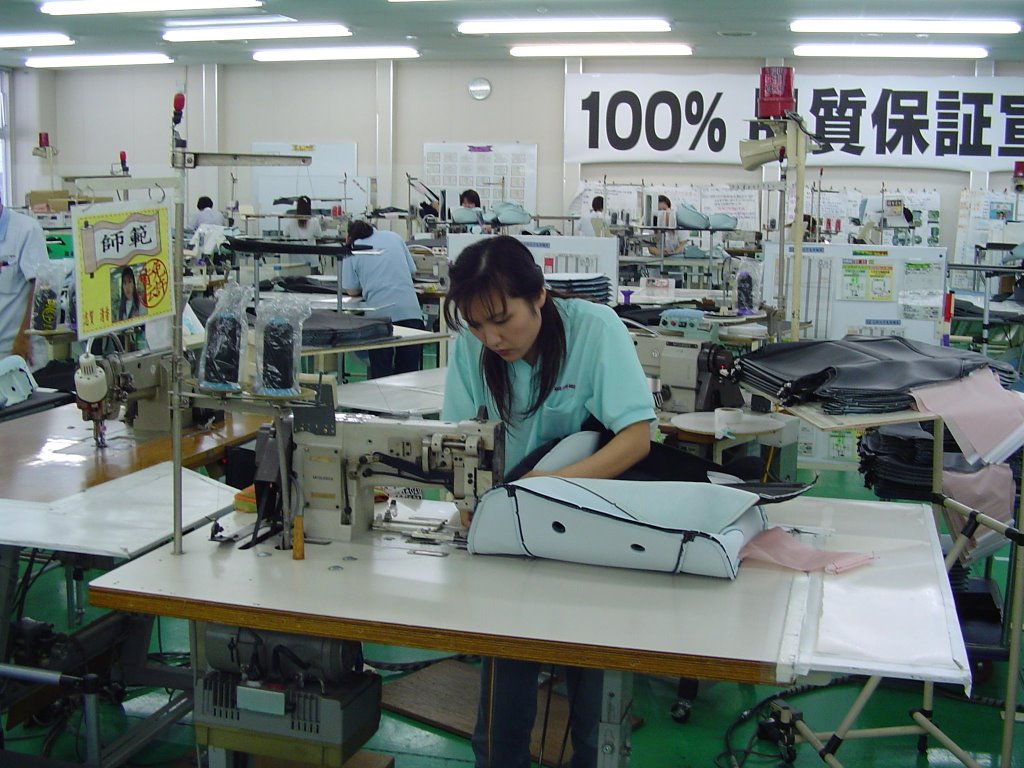
After the tour of the Toyota Motor Kyushu plant, our group headed to another factory in Southern Japan while there was still daylight to burn. We arrive later in the afternoon to the Nanjo Sobi Kogyo plant as the first foreign (Westerner) visitors every allowed to visit this extremely well run manufacturing facility.
Our host, Mr Yoshio Kaneko, Plant Manager, was extremely gracious to us for allowing this unique opportunity to see his operation. Prior to the official tour and Q/A period, the most honorable Mr Kaneko expressed his deepest sympathies to our group in remembrance of 9/11 on this 5th anniversary and sorrow for this tragedy against humanity. Arigato-Gozimas!
The Nanjo Sobi Kogyo plant, built in 1991, produces Seat Trim and covers for the automotive market. The operations include mainly fabric/leather cutting and sewing with a small group of 99 employees. The have outstanding kaizen spirit throughout their company from top to bottom with plenty of visual management and tremendous employee participation. The walls are filled with celebrated kaizen successes!
The biggest eye opener is the fact that all the operators sewing are standing up instead of the traditional sitting down. Standing up while performing work is more efficient yet some tasks like sewing are not considered suitable for standing. Mr Kaneko proves us wrong. Watching the operators move the fabric around with precision and ease while standing is a sight to behold. A typical cell is set up with one operator surrounded by 3 sewing machines set up for a specific model. The foot pedals are even fixed into position by a simple cutout in a board on the floor. Extremely cool to see in action!
The next thing that caught my attention is that the air and electric drops were missing from above. Typically, most manufacturing plants in the US drop air and electric lines from the ceiling to the workstations. Not at Nanjo Sobi Kogyo where the air and electric access come from the floor! A well designed trench system keeps the workstations supplied with power which really opens up the view of the shop floor. Outstanding!
These were just two of many improvements that surrounded us as we walked this very impressive plant. In parting, Mr Kaneko expressed some of his continuous improvement philosophy in that "Kaizen is part of work and not a program to be managed" and that "Kaizen should be embraced and not forced on to employees ". Certainly words of lean wisdom spoken from experience.
Japan Day 1 - Toyota Car of the Future
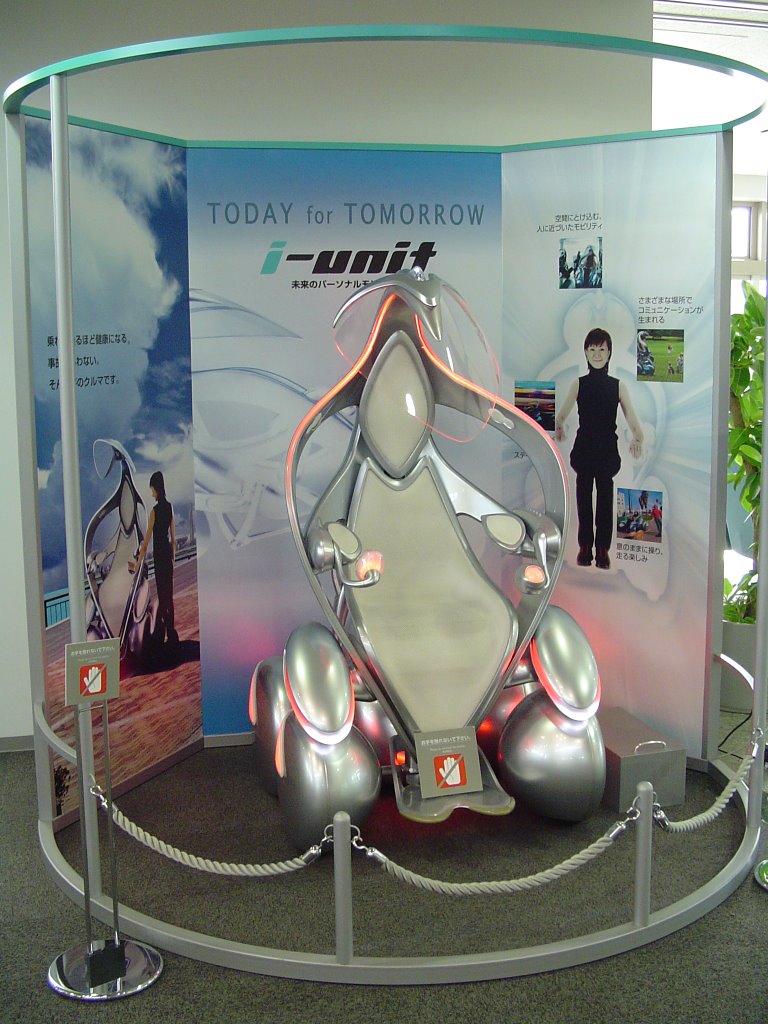
Here is a picture of Toyota's i-unit, car of the future, that was on display at the Kyushu automoble showroom . REALLY cool!
Japan Day 1 - Toyota Motor Kyushu

On our first manufacturing tour day in Japan, we wasted little time and proceeded directly to the pinnacle of lean manufacturing in the world, the Toyota Motor Company. After many years of reading, hearing and studying about Toyota with their successful Toyota Production System, I find myself standing today in the newest Toyota plant in Japan. My first impression is "WOW, these guys are REALLY good and they make manufacturing look easy."
The Toyota Motor Kyushu plant was built in 1991 and is one of 15 Toyota plant in Japan. This plant makes several different models including the Lexus IS 350, Lexus ES 350, Lexus RX 350, Harrier Hybrid and the Kluger (Highlander). Approximately 1,784 vehicles are produced per day for a Takt time of 60 seconds per vehicle with planned overtime currently in the schedule. The workforce is about 6,500 employees (almost double from a year ago!) . The percentage full time permanent employees to temporary employees is split even at 50%-50%.
The operations on site, performed in several buildings, include pressroom, welding, paint, assembly and inspection. The welding building contains 480 computerized robots hitting over 5,000 hit points (spot welds) on average per vehicle. All the doors, lids, hoods, etc are removed after the paint process, then re-fastened in assembly for easier access during assembly. The entire plant is air-conditioned for climate control. A total of over 2,800 different components are assembled on the painted bodies.
The assembly operation is divided between two buildings, the Lexus line in one and the Harrier/Kluger models in the other. The Lexus building was not open for tours for some "top secret" reason so our access was limited to the Harrier/Kluger line. In this building, all the models were run across a single assembly line with the line woven back and forth 11 times. Each of the 11 sections of assembly line is about 100 meters long and run independent of each other with a 5 car buffer between them. This buffer was a employee suggestion to keep portions of the assembly line running when one section was having a problem. A key example of Standard Work in Process.
Another implemented employee suggestion was a seat for the assembler working inside the vehicle called a "Rakuraku Seat". This seat moved with the conveyor line, with some stock bins attached, allowing the operator to swing inside the interior of the vehicle to perform their tasks then swing out while seated. It reminded me of those baby walkers as the operator propelled themselves down the line with their feet while sitting on the seat.
During our tour, assembly operators on several occasions pulled the stop cord on the assembly line due to a problem. In a matter of seconds, the floater for that area rushed over to the problem site. If the problem could be resolved in the remaining takt time, the line was started up again. Otherwise, the team leader was called in to help. If the problem could not be solved in 2 Takt Time cycles, the Line Leader was called in to help. At each level, the question was a simple matter of what degree was the problem, promoting quick response.
An interesting point is that the assembly line had a goal of only 97% uptime. They did not want 100%. It was believed that a goal of 97% was better (more realistic) and prevented quality problems from being slipped through. If the goal is 100%, the employees would say that something was not really a problem and let it go to keep at a target of 100%. With a target of 97%, the employees would not be pressured to let things go and stop the line to correct the problem!
The floater was the pivital position on the assembly line. This person's span covered about 4-5 line operators and performed tasks ranging from filling up bins (waterspider role), quick quality double checks, first responder to line problems from pulling the stop, absentee coverage, relief for line operators, etc. From my observation, this is a key role in the successful flow of Toyota's assembly line.
Another observation is the general material flow. I saw operators performing ONLY assembly tasks while the material handlers moved parts. With the Kanban card system and material coming in on multiple carts, it was like a well choreographed dance. Toyota made it look simple using only about a 1/2 day of inventory on the line. Except for the receiving and between buildings, there were no fork trucks handling material in the assembly plant. Electric carts pulled the material around the assembly line on flat bed carts. I saw as many as 5 material carts hooked together and pulled by one electric cart.
Overall, the flow of operations appeared well planned, very organized and made to look simple. For visual management, there were plenty of floor marks, small signs and other signals mainly dealing with material. Even the visual mangement was simple and did not clutter the walls or overtake the plant floor. With the number of line stops I saw today, it was apparient that Toyota is not perfectly run. I did not expect to see perfection today but Toyota comes very close.
Sunday, September 10, 2006
Japan Kaikaku Experience

I landed in Japan last night after a 27 hours journey but only 16 hours in the air. Here is the cool view from my 21st floor hotel room of the city of Kitakyushu, Japan. This trip is not a vacation but a learning experience hosted by Gemba Research called the Japan Kaikaku Experience. It is more of a lean learning mission in the heart of Japanese manufacturing. If you want to really see Japanese manufacturing first hand, there is no better way than joining the first class run tour experience that Gemba provides. So this week, I'll report my first experiences visiting Japan and most of all, my lean learning.
Wednesday, September 06, 2006
Lean Insider, a New Lean Blog
I just discovered a new lean blog called Lean Insider. The Lean Insider is written by Ralph Bernstein at Productivity Press and blogs about the latest news, research and trends on all things lean. Welcome Ralph to the lean blogging world!
Tuesday, August 29, 2006
Lean Blog Podcast Interview with Dr Jeffrey Liker
On our lean journey, we must continuously improve and continuously learn. Check out the podcast interview with Dr Jeffrey Liker, author of The Toyota Way, conducted by Mark Graban at Lean Blog. Mark continues to provide excellent lean lessons on his blog and check out his other podcasts featuring Norm Bodek.
Team Leaders Resource Library
Check out Karl McCracken's cool lean articles at Team Leaders Resource Library. Excellent work by a fellow lean guy from the UK including a closer look at shadow boards, etc. Karl helps companies improve using lean tools though his company, sevenrings. co.uk . He also has a site listing all the latest lean news from the web. Keep up the great work Karl!
Saturday, August 26, 2006
Stop Bumping Your Head
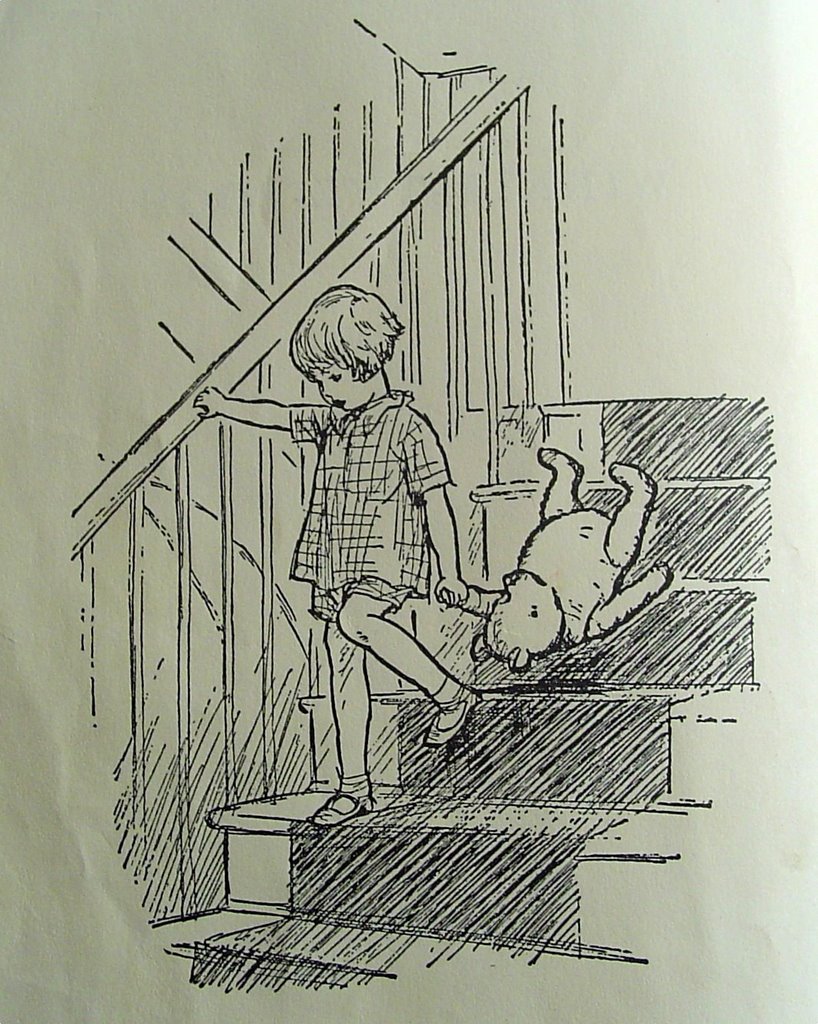
"Here is Edward Bear, coming downstairs now, bump. bump, bump, on the back of his head, behind Christopher Robin. It is, as far as he knows, the only way of coming downstairs, but sometimes he feels that there really is another way, if only he could stop bumping for a moment and think of it."
A. A. Milne, from Winnie-the Pooh, Chapter 1.
Art imitates life, so I am told. Based on what I see repeatedly at manufacturing facilities in America, it seems that a lot of us keep bumping our heads. It amazes me that, very much like Winnie-the-Pooh, we don't take a moment to think. We are too busy with the chaos of running (surviving) the day-to-day challenges of work that we never stop to find another way (a better way!).
For example, how many of us take the time to collect data on our plant efficiencies like First Pass Yield (FPY) and go so far as record the reasons for the non-conformance (putting them in fancy Pareto charts). The next day we repeat the same data collection and chart making activities only to repeat the whole data collect process the following day. (Bump, Bump, Bump!) Yet we never take the time to really go after the root causes of these recurring problems and put in the proper countermeasures (our moment to think).
What about when we collect data like downtime on our assembly lines or equipment complete with stratification by shift, by day of the week, by product? What about our safety audits and injury reports? What about our quality complaints from our customers, returned products and warranty claims? What about our scrap reports? What about our on-time delivery and delivery in-full reports?
Wherever I go, all this information is collected, organized, charted, reported and reviewed yet many times the reports you see on Monday will look strangely similar to the reports from last week, or the week before. Same old problems, different week. (BUMP, BUMP, BUMP).
There really is a better way, if only we can stop bumping for a moment and think of it!
Friday, August 11, 2006
Kaizen Hot-Wash
This afternoon, we completed another successful Kaizen 5-day event at an aerospace company in Indiana. The team was outstanding, the results were excellent and the kaizen event process was far from perfect, really meaning our kaizen implementation. Taking a page out of the military handbook, let's look at this kaizen event for lessons learned. Our military has long utilized the process of debriefing, or a "hot-wash" from what I have been told, to examine the lessons learned on the battlefield or training session for improvement and evaluation, providing a critical review of one's action. Here's what I learned from this kaizen event.
Lesson 1. Keep the kaizen training to what is actually needed for the event.
I learned this lesson long ago, abandoning the idea of packing as much training into the event as possible to increase value to the participants. It makes absolutely zero sense to go into the details of a SMED system (Single Minute Exchange of Dies) if your event has no change-overs as an obstacle to improvement. Yet, I have attended kaizen events where the training package was a canned program for the full day regardless of the scope of the kaizen event. Our kaizen event this week concentrated on throughput to the customer so the training was only a 1/2 day focusing on seeing waste, standard work and process flow. I spent too much time on some of the tools, time observation for one, which could have shortened the training time by 30 minutes.
Lesson 2. Provide the kaizen training at the right time.
Many kaizen event training programs spend valuable training time the first day teaching how to complete a report out on Friday. By the time Friday rolls around, they end up teaching this portion of the training all over again because everybody has forgotten the lesson during the week. Sounds like muda (waste) to me. I only mention the report out on Monday morning, leaving the details for Friday morning prior to the report out. When Friday arrives, I bring the team together for the quick "How-to-do-a-report-out" session and then the team goes to work without many questions. Did a good job on this one.
Lesson 3. Properly scale the scope of the kaizen event.
How many kaizen events bring an elephant to the table for a small team of five people to try to eat in one week? Although we love a challenge and admire a team that tries to tackle a huge project, the size of the scope matters. Keep the scope in line with the resources at hand. Our project was huge, covering over 30 process steps that encompassed over 10 days of well documented cycle time to complete one unit. It would have been impossible to cover all this work so we focused only on the waste in between these steps, walking and waiting. This scale could have been examined in more detail prior to the event.
Lesson 4. Measure twice, cut once.
After training on Monday at 12:30 pm , our kaizen team was ready for action. Time to go to gemba. With data collection activities through Tuesday afternoon, the team had a workable layout ready for maintenance support by 2:30 pm. A flurry of activity with equipment moves and scouring the area for our needs lead us to a transformed work area by 6:30 that night. Maintenance started without haste hooking up the new air and electric drops. The new layout was a tremendous improvement. Hurray!
But wait, the team started coming up with more ideas to try out. We asked the maintenance crew to hold up a bit while the team discovered the process of conducting multiple experiments to find the optimal layout. Only 5 layouts later, the team was satisfied with the results. Each of the 5 layouts shortened the distance traveled in the process, gaining an extra 5% improvement. Luckily, only a few of drops had any significant changes so we did not completely tick off our wonderful maintenance support crew. Do not become satisfied with idea A without trying multiple solutions (idea b, c, d, etc), you just might find a better way. Then call in the maintenance troops to action.
Lesson 5. Do not tick off your maintenance support crew.
Please see above.
Lesson 6. Pick the right lean tool for the job and use it well.
There are plenty of lean tools to choose for kaizen activities so your MUST determine the right tool and use it well. In our case, the spaghetti diagram was the best tool. It was simple to use although extremely time consuming for the large amount of travel in our process. The spaghetti diagram quickly showed the team the best areas for opportunity and was a great visual for comparison of layout options. Some of our time observations the first day did not end up providing much help with our focus on the in-between process wastes.
Lesson 7. Buy-in, Buy-in, Buy-in.
Without buy-in of the operators in a new process, the improvements of the week will not last past the Friday report-out. It is critical to get the process owners to buy-in to the new process. Of the five team members, we had one operator and one team leader of the process. All the other operators were asked for input and involved in the process of determining the layout each step of the way. Even with this high level of involvement, we had some unhappy campers. It took plenty of "please try it" and "what do you think?" before all the concerns were addressed. Several changes were not completely understood by those it affected and several detailed changes were not discussed outside of the team before we made them. It may take patience and effort on the part of the team to get buy-in. To be successful, you have no other choice!
Lesson 8. Watch out for collateral damage.
Our new layout had a ripple effect. We took over an area belonging to another process and ended up swapping areas with them. We had a layout for our area but not one for the ousted department. We moved our equipment around our plan with precision and piled up the other department's workbenches into our recently vacated area with reckless abandonment. Although we did provide air and electric to keep them running production the next day, they were not too happy with our thrown together layout. We ended up spending time the next day fixing the mess we left behind. The end results was a much improved process flow for both areas however we should have spent some quality time on the layout of the other area upfront.
Lesson 9. Keep your kaizen goals simple.
Many times a kaizen event will put a long list of targets or goals on the team to accomplish, productivity, cycle time, 5-S, floor space, quality, etc. All these goals are noble and beneficial however they may leave a team running in too many directions. Pick one goal to focus your kaizen team. Our kaizen goal was to improve the throughput of the process to the customer. We measured this goal with 1) time and 2) distance. Clear, simple and measurable. Good Job!
Lesson 10. Go to gemba and stay there the entire week.
With the exception of our Monday morning training and eating lunch, our kaizen team remained in our kaizen area the entire week. We had a meeting table, a few chairs and a flip chart placed in our kaizen area sharing information with the area (along with all those that passed by) throughout the kaizen process. Not only did this remove the muda of walking back and forth to an offsite meeting room, it also limited the team debates on the actual process. We shared information on display with our kaizen newspaper for all to see. No secrets, nothing to hide. Even the daily team leader meeting and the final report out were conducted at gemba. In fact, our Friday report out was attended by the owner of the company and his entire staff along with interested management from other departments seeing the actual improvements at gemba instead of relying on just descriptions of the changes in a stale conference room. Have the final report out at gemba, it will have a huge impact!
As stated earlier, the kaizen event results were excellent. We reduced the customer leadtime in days by 36% and shortened the distance traveled by 68% (from over 6, 800 feet to 2,199 feet). The spirit of kaizen was ignited at this company and they are ready for more!
Can the kaizen process be improved? Absolutely!
Lesson 1. Keep the kaizen training to what is actually needed for the event.
I learned this lesson long ago, abandoning the idea of packing as much training into the event as possible to increase value to the participants. It makes absolutely zero sense to go into the details of a SMED system (Single Minute Exchange of Dies) if your event has no change-overs as an obstacle to improvement. Yet, I have attended kaizen events where the training package was a canned program for the full day regardless of the scope of the kaizen event. Our kaizen event this week concentrated on throughput to the customer so the training was only a 1/2 day focusing on seeing waste, standard work and process flow. I spent too much time on some of the tools, time observation for one, which could have shortened the training time by 30 minutes.
Lesson 2. Provide the kaizen training at the right time.
Many kaizen event training programs spend valuable training time the first day teaching how to complete a report out on Friday. By the time Friday rolls around, they end up teaching this portion of the training all over again because everybody has forgotten the lesson during the week. Sounds like muda (waste) to me. I only mention the report out on Monday morning, leaving the details for Friday morning prior to the report out. When Friday arrives, I bring the team together for the quick "How-to-do-a-report-out" session and then the team goes to work without many questions. Did a good job on this one.
Lesson 3. Properly scale the scope of the kaizen event.
How many kaizen events bring an elephant to the table for a small team of five people to try to eat in one week? Although we love a challenge and admire a team that tries to tackle a huge project, the size of the scope matters. Keep the scope in line with the resources at hand. Our project was huge, covering over 30 process steps that encompassed over 10 days of well documented cycle time to complete one unit. It would have been impossible to cover all this work so we focused only on the waste in between these steps, walking and waiting. This scale could have been examined in more detail prior to the event.
Lesson 4. Measure twice, cut once.
After training on Monday at 12:30 pm , our kaizen team was ready for action. Time to go to gemba. With data collection activities through Tuesday afternoon, the team had a workable layout ready for maintenance support by 2:30 pm. A flurry of activity with equipment moves and scouring the area for our needs lead us to a transformed work area by 6:30 that night. Maintenance started without haste hooking up the new air and electric drops. The new layout was a tremendous improvement. Hurray!
But wait, the team started coming up with more ideas to try out. We asked the maintenance crew to hold up a bit while the team discovered the process of conducting multiple experiments to find the optimal layout. Only 5 layouts later, the team was satisfied with the results. Each of the 5 layouts shortened the distance traveled in the process, gaining an extra 5% improvement. Luckily, only a few of drops had any significant changes so we did not completely tick off our wonderful maintenance support crew. Do not become satisfied with idea A without trying multiple solutions (idea b, c, d, etc), you just might find a better way. Then call in the maintenance troops to action.
Lesson 5. Do not tick off your maintenance support crew.
Please see above.
Lesson 6. Pick the right lean tool for the job and use it well.
There are plenty of lean tools to choose for kaizen activities so your MUST determine the right tool and use it well. In our case, the spaghetti diagram was the best tool. It was simple to use although extremely time consuming for the large amount of travel in our process. The spaghetti diagram quickly showed the team the best areas for opportunity and was a great visual for comparison of layout options. Some of our time observations the first day did not end up providing much help with our focus on the in-between process wastes.
Lesson 7. Buy-in, Buy-in, Buy-in.
Without buy-in of the operators in a new process, the improvements of the week will not last past the Friday report-out. It is critical to get the process owners to buy-in to the new process. Of the five team members, we had one operator and one team leader of the process. All the other operators were asked for input and involved in the process of determining the layout each step of the way. Even with this high level of involvement, we had some unhappy campers. It took plenty of "please try it" and "what do you think?" before all the concerns were addressed. Several changes were not completely understood by those it affected and several detailed changes were not discussed outside of the team before we made them. It may take patience and effort on the part of the team to get buy-in. To be successful, you have no other choice!
Lesson 8. Watch out for collateral damage.
Our new layout had a ripple effect. We took over an area belonging to another process and ended up swapping areas with them. We had a layout for our area but not one for the ousted department. We moved our equipment around our plan with precision and piled up the other department's workbenches into our recently vacated area with reckless abandonment. Although we did provide air and electric to keep them running production the next day, they were not too happy with our thrown together layout. We ended up spending time the next day fixing the mess we left behind. The end results was a much improved process flow for both areas however we should have spent some quality time on the layout of the other area upfront.
Lesson 9. Keep your kaizen goals simple.
Many times a kaizen event will put a long list of targets or goals on the team to accomplish, productivity, cycle time, 5-S, floor space, quality, etc. All these goals are noble and beneficial however they may leave a team running in too many directions. Pick one goal to focus your kaizen team. Our kaizen goal was to improve the throughput of the process to the customer. We measured this goal with 1) time and 2) distance. Clear, simple and measurable. Good Job!
Lesson 10. Go to gemba and stay there the entire week.
With the exception of our Monday morning training and eating lunch, our kaizen team remained in our kaizen area the entire week. We had a meeting table, a few chairs and a flip chart placed in our kaizen area sharing information with the area (along with all those that passed by) throughout the kaizen process. Not only did this remove the muda of walking back and forth to an offsite meeting room, it also limited the team debates on the actual process. We shared information on display with our kaizen newspaper for all to see. No secrets, nothing to hide. Even the daily team leader meeting and the final report out were conducted at gemba. In fact, our Friday report out was attended by the owner of the company and his entire staff along with interested management from other departments seeing the actual improvements at gemba instead of relying on just descriptions of the changes in a stale conference room. Have the final report out at gemba, it will have a huge impact!
As stated earlier, the kaizen event results were excellent. We reduced the customer leadtime in days by 36% and shortened the distance traveled by 68% (from over 6, 800 feet to 2,199 feet). The spirit of kaizen was ignited at this company and they are ready for more!
Can the kaizen process be improved? Absolutely!
Wednesday, July 26, 2006

Subscribe to:
Posts (Atom)